
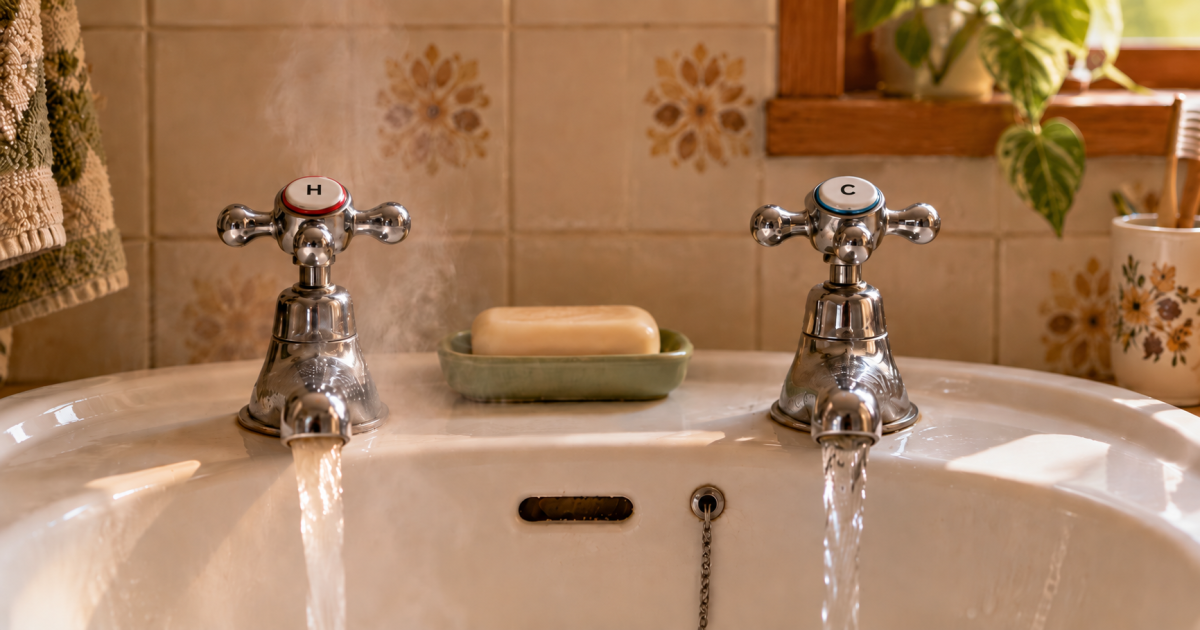
Growing up in Werribee in the 90s, both houses my family lived in had two taps but a single spout, so the hot and cold actually mixed in the pipes before it ever reached your hands. Every tap was clearly labelled too, sometimes the full HOT and COLD spelled out, sometimes just H and C, sometimes nothing more than a red dot on one side and a blue one on the other. Whatever the system, ours was consistent and unambiguous. Hot was always on the left, cold on the right, in both houses. It became such an ingrained assumption that I never even noticed I had it until years later.
Same labels, opposite order everywhere else
Then you’d go to somebody else’s older house, a grandparent’s place, a rental, a friend’s family home, and the same markings, whichever version they used, would be sitting in the opposite order. Hot on the right this time. It genuinely felt like 50/50 odds walking into any older house, and the system I’d trusted my entire childhood turned out to be a coin flip everywhere else.
I honestly can’t tell you now whether I actually minded warm water as a kid, these days I default to cold every time and can’t be bothered waiting for a tap to heat up, but if I had to guess, the real issue was never about preference anyway. It was reaching for what should have been the cold tap and copping a blast of hot instead, which hurts a lot more than getting cold water by mistake.
Some houses never mixed the water at all
Some older places skipped the shared spout completely. Two taps, sure, but two separate spouts as well, one straight hot and one straight cold, with nowhere for the two to actually meet. No in-between temperature to aim for, just two individual streams landing wherever they landed in the basin, and you doing the mixing yourself, plug in, fill from one side, top up from the other.
Why the two-tap system actually existed
I went down a bit of a rabbit hole trying to work out why anyone would design a sink like that, and it turns out it wasn’t just old plumbing being difficult for the sake of it. Heating water used to cost real money and real effort, whether that was fuel for the copper in the laundry or an early gas hot water service, so nobody wanted to run it freely down the drain while fiddling with the temperature at the tap. You filled the basin instead, that’s genuinely why it had a stopper in the first place, adding exactly the hot and cold you needed for whatever you were doing, washing your hands or having a shave, then using that water rather than wasting it under a running stream.
Once you know that, the two-spout basin stops looking like an oversight and starts looking like a pretty sensible system for its time. Wasteful running water was the actual problem it was solving, decades before anyone was talking about water ratings on anything.
Now I’m the one running the bath
Fast forward a few decades and I’m not the kid guessing at taps anymore, I’m the parent standing over a bath testing the water with my wrist before my own kid gets anywhere near it. The stakes go up a fair bit when it’s not your own hand on the line.
That’s when a single lever really starts to make sense. Most bathrooms these days have moved to single-lever mixer taps, where one motion controls both temperature and flow instead of two separate taps to wrangle. No guessing which side does what, no learning curve for a toddler working out a tap for the first time, just one smooth turn from cold to exactly as warm as you actually want it.
The charm hasn’t completely disappeared
There’s still a certain charm to the old two-tap setup, whether yours had one spout or two. It belongs in a heritage bathroom the same way a claw-foot tub does, and plenty of people bring it back deliberately for the look. Charm and childproofing don’t always line up though, and if you’ve ever had a toddler shriek because they picked the wrong tap, you’ll get why most of us don’t miss the guessing game as much as we thought we would.