Charlie and Alex are both still at childcare, but I’ve already learnt that you don’t need to be at school to get swept up in a craze. Charlie is five, and Minecraft hit him hard long before he actually knew how to play it. He’s getting pretty good at it now, but for a while he “liked” it purely because it was everywhere. Alex is three and loves Ooshies from Woolworths, even though the 2026 promo finished a few weeks ago. I think Ooshies are basically this generation’s Tazos. You get them with the shopping, and once you’ve started collecting them, there’s no stopping.
It’s got me wondering what Charlie and Alex will be bringing home from school in a few years that ends up on some teacher’s banned list.
When I was at primary school in Werribee in the 90s, and later in high school, it felt like there was a new must-have thing every term, and word got from one end of the quadrangle to the other in about a day. Some lasted a few weeks. Some got banned. A surprising number are still around, or keep coming back every few years for a new generation of kids, which I find a bit hard to believe. If you’ve got photos of your old collection you’d be happy for me to add, send them through on Facebook.
A quick note on scope before we get into it. This is a list of schoolyard fads and crazes specifically, not just big things that happened to be around at the time. Things like Star Wars in 1997 and 1999, Space Jam or the Sydney 2000 Olympics were massive cultural events, but I haven’t covered them here in their own right. They only get a mention where they crossed over into an actual schoolyard fad, like a Tazos promotion, because what I’m really after is stuff that was tied to schoolyard conversations, lunchtime games, or the walk to and from school.
This list is roughly in chronological order, which means it kicks off with Trolls, and I’ll admit that feels like a slightly weak start. They’d already peaked just before I started school, so I never actually saw the craze in the classroom. Leaving them off felt wrong though, so here we are.
Troll Dolls
Trolls were huge from about 1990 to 1992, which was just before I started school, so I never saw them at their peak in the classroom. The originals were created by Danish sculptor Thomas Dam in the 1950s, but the 90s revival was a whole new level. The Smithsonian says Russ Berrie alone had sold around US$150 million worth of trolls by 1992. There were also Treasure Trolls with rhinestone belly buttons.
Trolls were seen as a girls’ toy, though, so the toy companies went all out trying to sell them to boys. Hasbro made Battle Trolls from 1992, and competitors quickly followed with Troll Warriors from Tyco and Troll Force from Toys ‘n Things. Ace Novelty had Stone Protectors, a 1993 toy line and cartoon about a rock band who turn into troll-like warriors, which tried so hard not to look like trolls that it dropped “trolls on a roll” from its own theme song. Plenty of other brands jumped on the big-hair troll bandwagon too. Playmates even got in on it in 1992 with Turtle Trolls, a line that turned Leonardo, Michelangelo, Donatello and Raphael into trolls, wild hair and all.
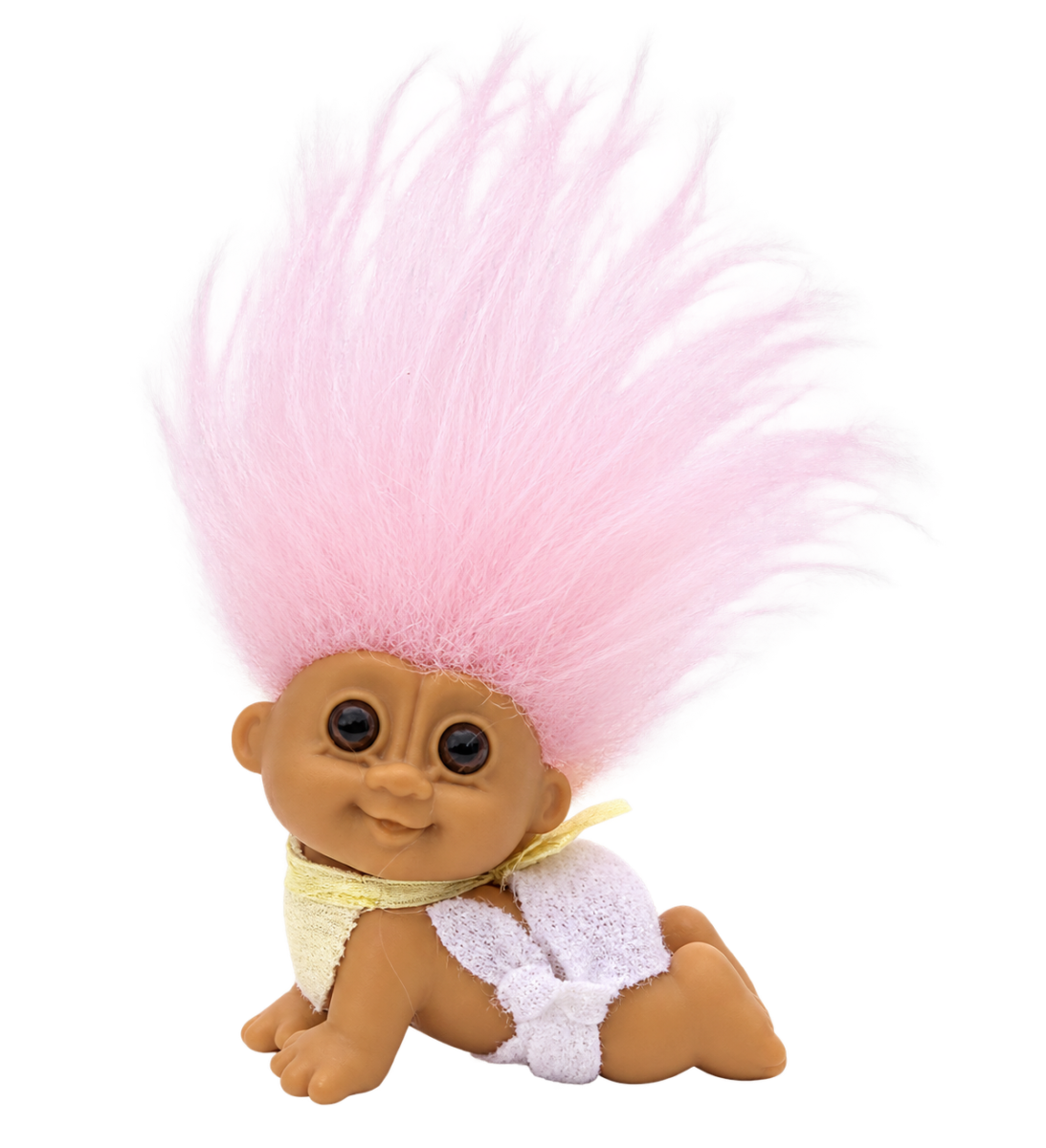
I also had a few little troll pencil toppers and similar bits and pieces, probably bootleg ones going by how cheap they were, along with a couple of the “boys” style troll figures from those other brands trying to cash in. None of those ever made it to school with me though. I didn’t take many of my toys to school at all, mostly out of fear they’d get lost or broken. The only proper troll I remember owning was a tiny Russ Berrie crawling baby troll with light pink hair, which I bought myself on a family holiday to Brisbane. It was ridiculously cute, and I thought it would scale well with my other toys. When I showed it to my nanny, my grandmother on my mum’s side, she asked if it was for her, and I awkwardly said yes and let her keep it. She kept it on the bedhead for decades, so I guess she appreciated it. I have it back now that she’s passed, although I can’t find it at the moment, so the photo above is from an online listing.
Trolls did properly fade away for a while after that, but they had a weird resurgence when DreamWorks bought the rights in 2013 and turned them into an animated film series starting in 2016, with Justin Timberlake voicing one of the leads, which seems fitting given what he was doing with his hair in the 90s. Nothing beats the original doll’s aesthetic though. I think the new ones look ridiculous.
Power Rangers
Mighty Morphin Power Rangers first aired in the US on 28 August 1993, and it wasn’t long before our schoolyard was full of kids doing absolutely shithouse fake karate kicks at nothing.
The biggest impact wasn’t the toys, it was lunchtime. We’d spend far more time arguing about who got to be Jason, the original Red Ranger and leader, or Tommy, who started as the Green Ranger before becoming the White Ranger, than we ever spent actually pretending to fight. By the time it was sorted out, the bell had usually gone. My favourite was always Zack, the Black Ranger, and I had one of the Auto-Morphin figures of him, where you flipped his head around to switch between Zack and his helmet.
It had serious staying power. The TV series ran for 30 seasons before wrapping up in 2023, so there’s a good chance your own kids have seen a version of it. Alex is already proof of that. He’s obsessed with Power Rangers across a whole stack of different series, with Beast Morphers as his current favourite, but it’s specifically the Blue Rangers he loves, whichever series they’re from. He takes his Blue Ranger figures to childcare and pretty much everywhere else we go.
My sister got him a Red Ranger costume for his third birthday, so naturally I couldn’t resist getting him AI-added into his very own Beast Morphers team below. Going forward, I’ll be doing my best to track down an actual Blue Ranger costume for him instead.

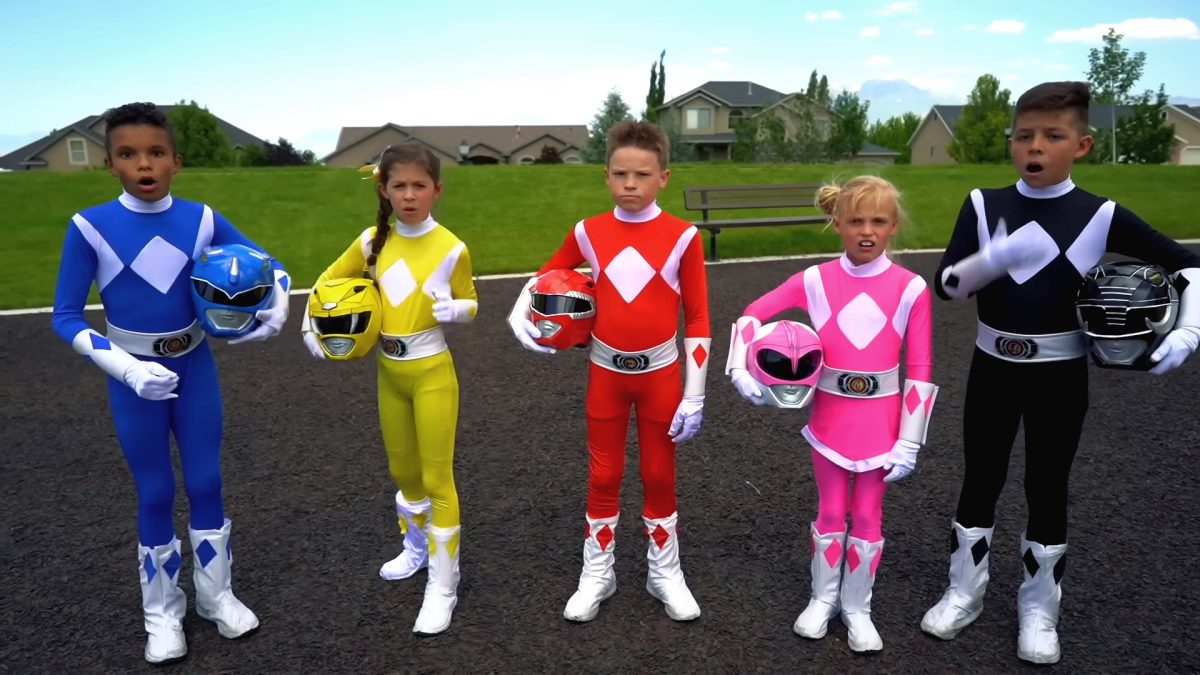
The fan reenactment side of things has come a long way since we were just doing it at lunchtime too. Ninja Kidz TV, pictured above, have taken it a step further, putting together their own full retelling of the original series with kids in every role. With a proper new Power Rangers series yet to actually land, they’re doing a pretty good job of filling that gap for a new generation of kids in the meantime.
Monster in My Pocket
Monster in My Pocket arrived right at the start of the decade. The small soft plastic monsters were released by Matchbox in 1990, and there ended up being more than 200 of them across the original series. Each one had a point value, which was supposed to be part of a game, but I think most of us just collected them.
My favourite was the Hydra. It was one of only six monsters worth the maximum 25 points in the first series, according to this Series 1 checklist, alongside the Werewolf, Griffin and T-Rex. The other two I remember most were Spring Heeled Jack and the Ghost, both only worth 10 points, but memorable all the same.
A lot of kids didn’t even get them from a toy shop. Matchbox also released them through Pizza Huts in the UK, the US and Australia, and they were exactly the same toys you could buy in the shops. Each character came in multiple colours too, which made collecting a full set even harder.
I went down a bit of a rabbit hole with these in my Pizza Hut memories article, after buying 44 of the 48 original Pizza Hut colours from a Facebook Marketplace seller whose mum managed a Pizza Hut in the 90s. Collectors still can’t quite agree on how many you could get here, so if you worked at a Pizza Hut back then, I’d love to hear from you.
I’ve since finished my Series 1 collection, sticking to just one of each character rather than chasing every colour variant. A guy at my old work filled in my last gap, which felt like a fitting way to complete something that started in a schoolyard almost 30 years ago.
Polly Pocket & Mighty Max
Polly Pocket and Mighty Max were tiny playsets that folded up into a case small enough to fit in your pocket, which made them perfect for bringing to school. They were cheap enough to be a go-to birthday present too, so it felt like every party had at least one being unwrapped.
Polly Pocket came first. It was released by UK company Bluebird Toys in 1989, with a tiny doll that lived inside a compact-shaped case, according to Wikipedia. Mattel bought Bluebird in 1998 and redesigned Polly into a bigger, more lifelike doll with weird rubbery clothes you could dress her in, which made the “Pocket” part of the name a bit of a stretch. It was probably a decent toy in its own right, and I’m sure plenty of people look back on it fondly, but as far as I’m concerned it just was not what Polly Pocket was supposed to be. Mattel would have been better off giving it a different name entirely. The good news is that they’ve since course-corrected, releasing compact-sized sets through Mattel Creations that are much closer to the original in spirit, just with a more modern look. They also do straight retro reissues based on the original designs, plus pop culture crossover compacts for things like Clueless, Stranger Things, Back to the Future, Friends and The Office. I’ve bought most of these for my sister as birthday and Christmas presents over the years.
Bluebird followed up with Mighty Max in 1992, which was essentially Polly Pocket for boys. Instead of cute houses and gardens, the cases were shaped like skulls and monster heads, and they opened up into little horror-themed playsets with a tiny Max figure. It even got its own cartoon in 1993.
Mighty Max was my thing. I was obsessed with ancient Egypt at the time, so my first one was the Egyptian set shaped like a rattlesnake, which I’m fairly sure was the Palace of Poison. I ended up with a really good collection, including three of the four big playsets and most of the Doom Zones, the head-shaped sets that opened up. I didn’t care much for the smaller Horror Heads, because there wasn’t much you could actually do with them.
Then Star Wars Micro Machines took over, Mighty Max stopped being made, and Mum talked me into selling my whole collection for $50 to my dad’s mum’s support worker, so she could give it to her grandkid. It has since cost me thousands of dollars to buy it all back. The tiny parts always got lost, so complete sets are worth a lot now. That $50 might be the worst deal I’ve ever made.
Slap Bands

Slap bands went by a few names depending on who you asked. Some kids called them snap bands, and in the US they were slap bracelets or snap bracelets. They were a strip of metal covered in fabric or plastic that sat flat and straight until you slapped it against your wrist, where it curled up instantly. They came in every colour and pattern you could think of, from neon animal print to glow in the dark. I think my first one was covered in a silver holographic pattern.
They were invented by Stuart Anders, a teacher in Wisconsin, who originally called them the “Slap Wrap”, according to their Wikipedia entry. They took off in the early 90s, and then, like half of this list, they got banned from schools. The cheap knock-offs used thinner steel that could break through the cover and cut your wrist, which is exactly what happened once kids had been slapping them on and off all day.
Trading Cards
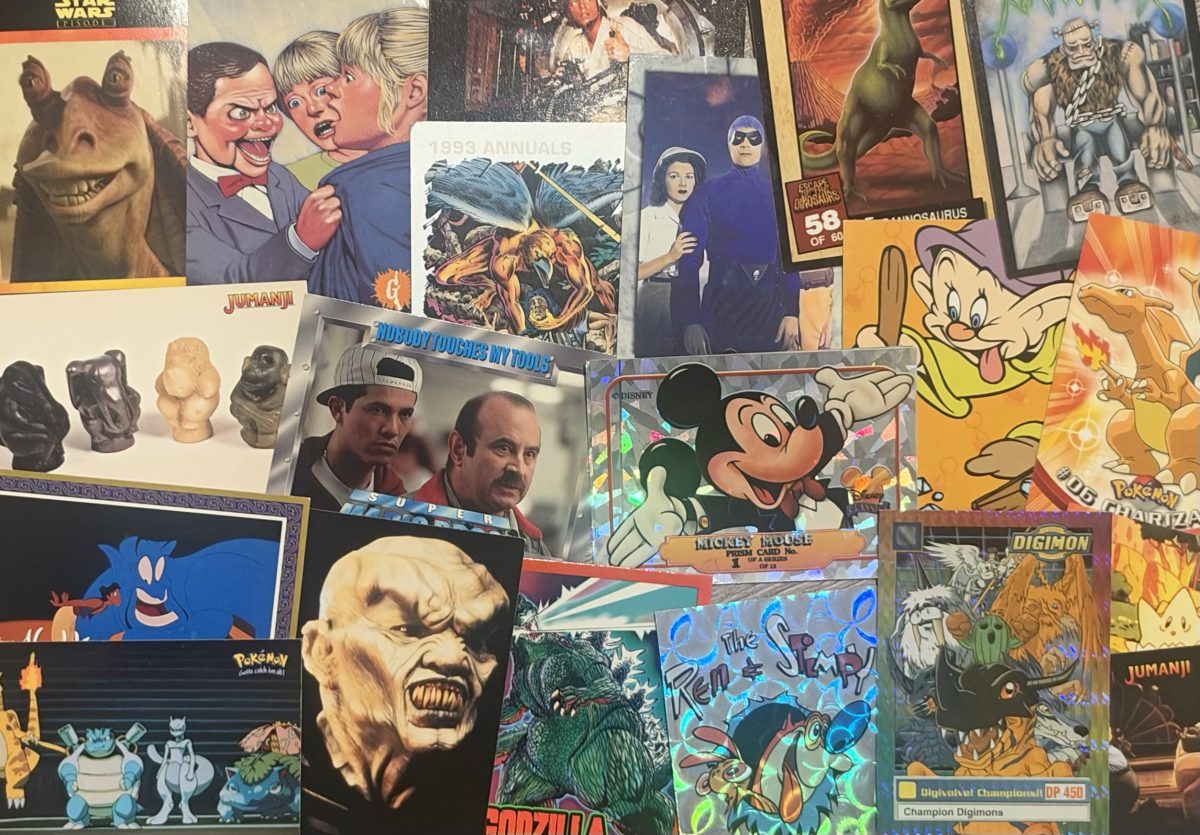
Before the internet, if you liked something and wanted to look at nice colour pictures of it whenever you wanted, trading cards were the way to do it. They weren’t just for sport either. Almost every cartoon, movie and toy line had a set, and even action figures and other merch would sometimes come with a bonus card thrown in.
I mostly collected various Disney sets and Goosebumps. Other kids at school collected AFL footy cards, and American basketball cards were surprisingly popular too. Don’t worry, I’ll get to the Pokémon trading card game later.
I’ve kept buying the odd set as an adult. When Card Mania in Geelong was closing down, I picked up a Sonic the Hedgehog set and a Ren and Stimpy set, which I didn’t need but couldn’t resist.
As for whether any of our old cards are worth anything now, I wouldn’t get your hopes up. A lot of cards from the late 80s and early 90s were printed in such massive quantities that they lost any real value, which collectors now call the junk wax era. By 1987, Topps alone was printing around 2 billion cards a year. I don’t think most of mine are worth much to anyone but me.
Tazos
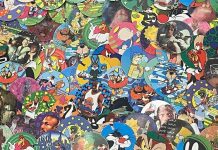
Pogs were the big thing in America, but here it was all about Tazos, and I think ours were better because you got them free in a packet of chips. The first Australian set was Looney Tunes in 1995, followed by The Simpsons in 1996, Space Jam in 1996 and Star Wars in 1997. There were also a couple of Chester Cheetah sets in 1995 and 1996, featuring Cheetos’ own mascot.
The whole pog and cap craze was so big at the time that it wasn’t just about chip packets. Crown & Andrews put out a set of AFL collectable pogs in 1995, and there was even a glow-in-the-dark Mighty Morphin Power Rangers caps game that same year. I couldn’t find any evidence that Oddbodz ever did a caps or pogs version of their own, just the cards, but I’d love to be corrected if anyone remembers otherwise.
For a lot of kids they basically worked as currency, and some traded their lunch for a handful. The game was simple. Stack them up, smash them with your slammer and keep whatever flipped. I didn’t play for keeps myself, though. I was happy just collecting them.
The Star Wars set was where I stopped. I had every single Tazo up to that point, except for the last page, a run of silver, chrome-looking metallic ones that only came out for a few weeks right at the end of the Star Wars promotion. After that came the Batman and Robin Movie Clip Tazos, which used little film slide-looking cards and came with their own viewer instead of the usual Tazo shape, and that was different enough that it lost me completely.
I already knew the Pokémon and Digimon discs we got in chips here weren’t actually sold as Tazos, just similar collectables under their own names, and the last proper Tazos were AFL and NRL players in 2008. Fans have campaigned to get them back for years, but Smith’s said it had no plans to do so when asked about it in 2020.
Oddbodz
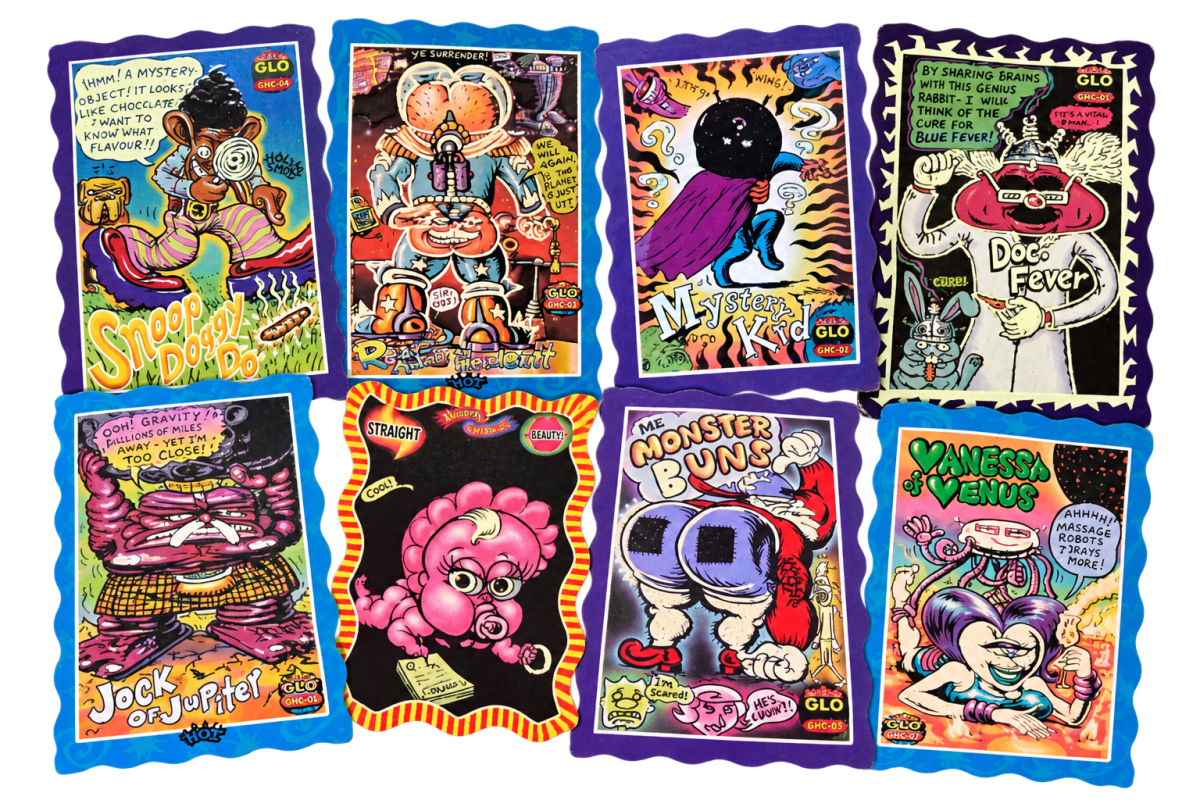
If Tazos were the thing you really wanted from a packet of Smith’s, Oddbodz were the other surprise you’d sometimes get. They were collectable cards of gross, weird little characters drawn by artist Andy Hook, and they came free with Smith’s products in Australia and Bluebird products in New Zealand between 1995 and 1997, according to this Oddbodz fan archive.
There were seven series in total, including Oddbodz Glo, Oddbodz Space, Twisted Oddbodz and even Footy Oddbodz. The best ones were the HOT cards, which had a heat-sensitive print that revealed a hidden picture when you rubbed it. There were also rarer orange glow versions and the “blue fever” HOT cards, which you could redeem for a complete set.
If Oddbodz reminded your older siblings of something, it was probably Garbage Pail Kids. Topps released them in 1985 as a gross-out parody of Cabbage Patch Kids, with cartoonist Art Spiegelman as the main creative force, and they were banned in many schools for being a distraction. Oddbodz had the same disgusting sense of humour, just with the added bonus of coming free in your chips.
I never owned any Oddbodz, but they were too iconic to skip. Like Tazos, they worked as playground currency, and it felt like everyone else had a stack of them.
Giant Jawbreakers & Ghost Drops
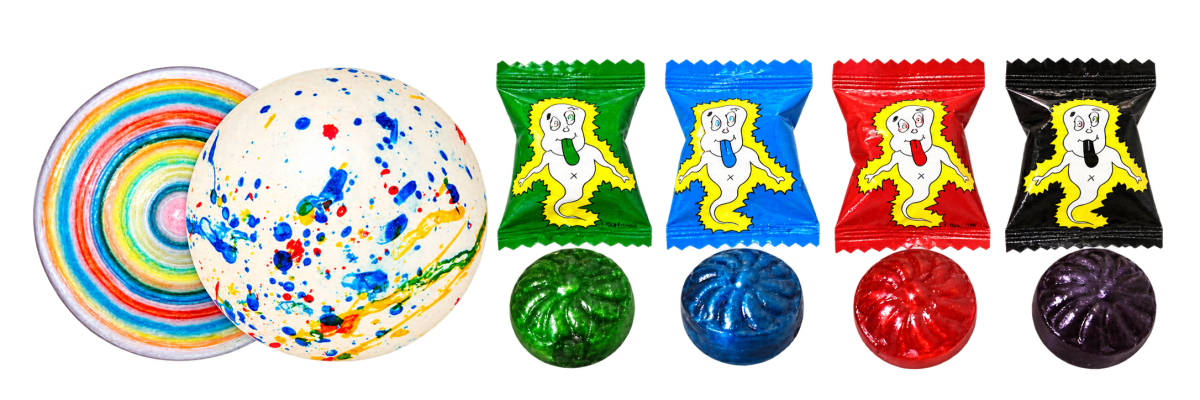
I’ve already covered what was in our lunchboxes in my 90s lunchbox and schoolyard snacks article, but lollies deserve a mention here as well.
The giant jawbreaker was something everyone had to try at least once. They were made by rolling a small lolly centre in sugar syrup over and over until it built up layer after layer, a process that can take days or even weeks, which is probably why it felt like they took just as long to eat.
Our local milk bar in Werribee was Gerald & Lou’s, on the corner of one of the streets bordering Werribee Primary School. It’s since been replaced by a very mediocre cafe, but back then the most popular thing there wasn’t a jawbreaker at all, it was Ghost Drops. They’re little individually wrapped hard lollies that change the colour of your mouth as you eat them, and you can still buy them today. They look a lot neater these days, with a swirly pattern on each one. Every Ghost Drop I ever had as a kid looked like it had melted and reformed in the packet before it was sold.
School Milk Stickers
Before recess snacks got so heavily regulated, a lot of Victorian primary schools, and I’d guess other states had something similar, ran a school milk program. You could order a full cream milk with a blue lid, or a low fat one with a red lid, which I’m fairly sure was REV, a low fat milk brand that had actually been around in Victoria since 1978.
What I remember most wasn’t the milk itself though, it was the sticker stuck to the top of the lid, which you could peel off and collect. I couldn’t track down anything online confirming exactly what these stickers looked like or what they were part of collecting towards, so if you remember more about them than I do, I’d love to hear it.
Yo-Yos
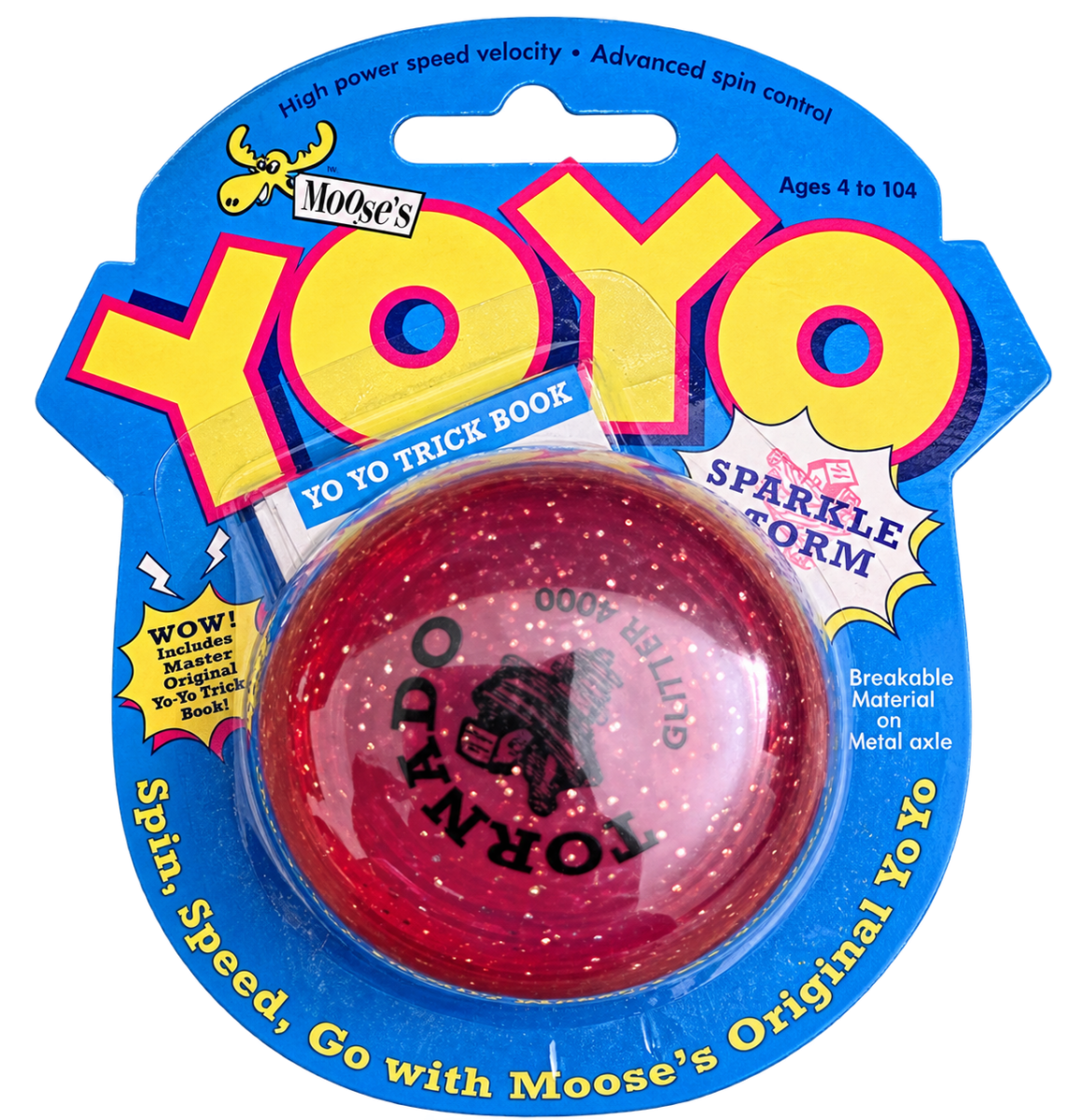
Yo-yos seem to come back about once a decade. Coca-Cola teamed up with the Russell yo-yo company back in the late 1950s, and the Coke yo-yos were an instant hit here, with more revivals in the 70s and 80s, according to YourLifeChoices. By the 90s, everyone still seemed to have a Coke yo-yo lying around, but it was the weirder designs like the Yomega Fireball and The Brain that set the decade apart.
At my school though, the most popular ones were Moose yo-yos. I didn’t realise until years later that Moose was actually a Melbourne company, founded in Cheltenham in 1985, and the same business that went on to make Mighty Beanz and Shopkins. One of their Tornado Glitter 4000 yo-yos is even held by the Strong National Museum of Play in the US, which I find quite funny.
I ended up with two. One was a pink glitter Tornado just like this one, which came with a little trick book and was apparently suitable for ages 4 to 104. Mine was slightly damaged on the inside, so you could see and hear little bits of broken plastic rattling around every time it spun. In fairness, the packet did warn it was made of “breakable material”. The other was a black and chrome one, which I’m fairly sure was an Ultrasonic Chrome 2000. I could only ever do a few tricks, like rock the cradle and walk the dog. At some point I also got a Tazos yo-yo, where you could pop the clear panels off each side and put your favourite Tazo behind them. It was a great idea, but it was nowhere near as slick as a Moose one.
Knuckleheads
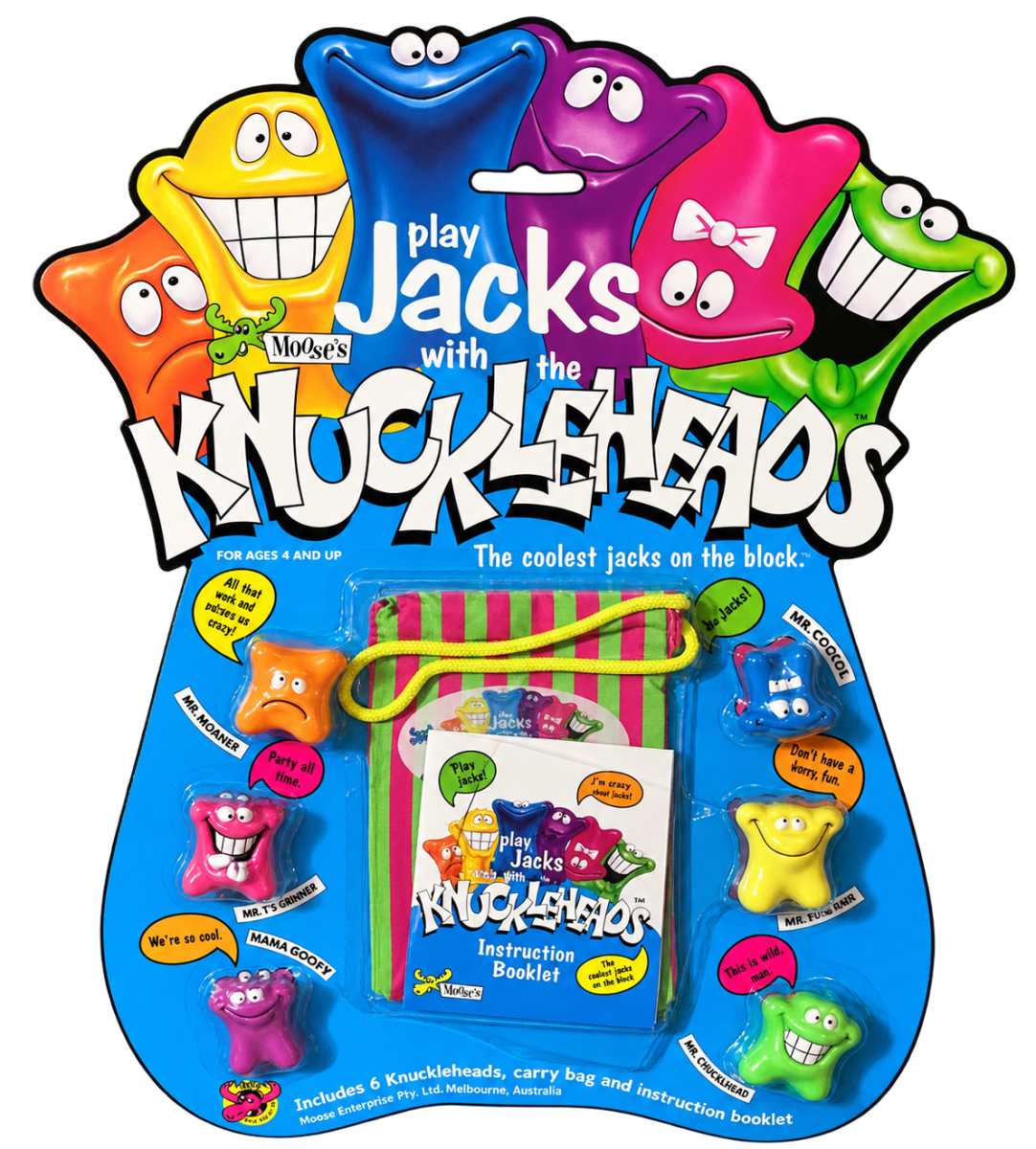
I’m honestly not sure how big Knuckleheads were, or whether they were popular enough to count as a proper fad, but I couldn’t leave them out. They were made by Moose, the same Melbourne company behind my yo-yos, and were sold as “the coolest jacks on the block”. Each one was a brightly coloured knucklebone with its own cartoon face, and a sealed set from around 1997 is now part of the Museums Victoria collection, complete with the drawstring bag and instruction booklet.
Around the same time, a lot of kids were collecting a similar thing called Crazy Bones, but I don’t remember them being much of a thing at my school.
What I loved about Knuckleheads was that every one had so much personality. There was Mr Moaner with his grumpy frown, Mama Goofy, Mr Chucklehead with his massive grin, and a few others I’d forgotten until I saw the packet again. I played with them as little figurines far more than I ever used them for jacks.
Tamagotchi
The Tamagotchi was the first thing I remember that stressed kids out. It came out in Japan in 1996 and the rest of the world in 1997, and the whole point was that your pet would die if you ignored it.
The problem was that the original couldn’t be paused, so kids brought them to class and schools started banning them, as the Strong National Museum of Play points out. I never had a real Tamagotchi, but plenty of kids at school did, and between them and my own off-brand one, I have no idea how any of us managed to keep our virtual pets alive through a school day.
It never really disappeared either, with over 98 million sold worldwide as of 2025.
Digimon & Other Virtual Pets
Once Tamagotchi took off, everyone made one. The best known was probably the Digimon, which Bandai released in 1997 and which could connect to another unit so your pets could fight. There’s a good rundown of the original Digital Monster if you want to see which version you had.
I didn’t have one and never really got into the show, but I remember watching other kids battle them. They’d press their devices together to start the fight, then mash the buttons like it would change the result. Even then it never made sense to me. There was no Bluetooth or WiFi back then, so I figured the winner was decided the moment the two devices touched. It turns out I was mostly right. You had no control once a battle started, and the result came down to your Digimon’s power, stage and attribute, with a bit of luck thrown in. Fans have since worked it all out, and there’s even a hit rate calculator for it.
The closest I got was a few random packets of Digimon cards my dad brought back from the US just for fun. They weren’t even for a game, just collector cards with pictures from the cartoon.
My first virtual pet was one of the cheaper off-brand ones, which I think is what a lot of us ended up with. Tiger Electronics released Giga Pets in 1997 in the middle of the virtual pet craze, and later on I got their Star Wars Rancor. Tiger made three Star Wars Giga Pets, Yoda, R2-D2 and the Rancor, and feeding it meant watching a Gamorrean Guard drop into its pit, just like in Return of the Jedi. That was a lot more fun than feeding a pixelated chicken.
Beanie Kids & Beanie Babies
Beanie Kids were Australia’s answer to Ty Beanie Babies. They were made by Skansen, and the first ones were released in September 1997, right in the middle of the Beanie Babies craze. The early releases were a real mix of different animals, much like Ty’s were at the time, before Beanie Kids later settled into being mostly bears with different costumes and accessories. I’ve got a feeling there was some kind of cease and desist behind that shift, though I can’t actually confirm that, so take it as a theory rather than a fact.
My sister loved them. She had plenty of Beanie Kids, but every now and then Dad would bring her home a proper Ty Beanie Baby from one of his trips to the USA, which were considered far superior. Ty had launched them in 1993, and deliberately kept supply tight, limiting how many of each design a store could stock and retiring older ones, which only fuelled the speculative frenzy. That made them hard to get hold of in Australia, since most of what was made was being snapped up and resold in the US before it ever had a chance to reach us. By the late 90s they were such a big deal that they made up 10% of eBay’s sales, per Wikipedia. Most of them are worth next to nothing now that the bubble has well and truly burst.
Furby
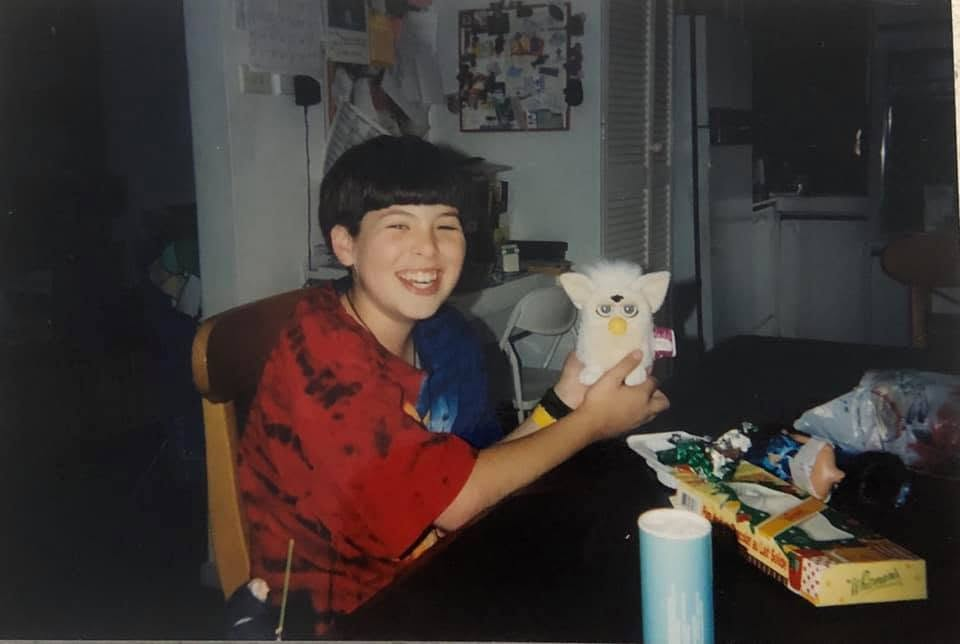
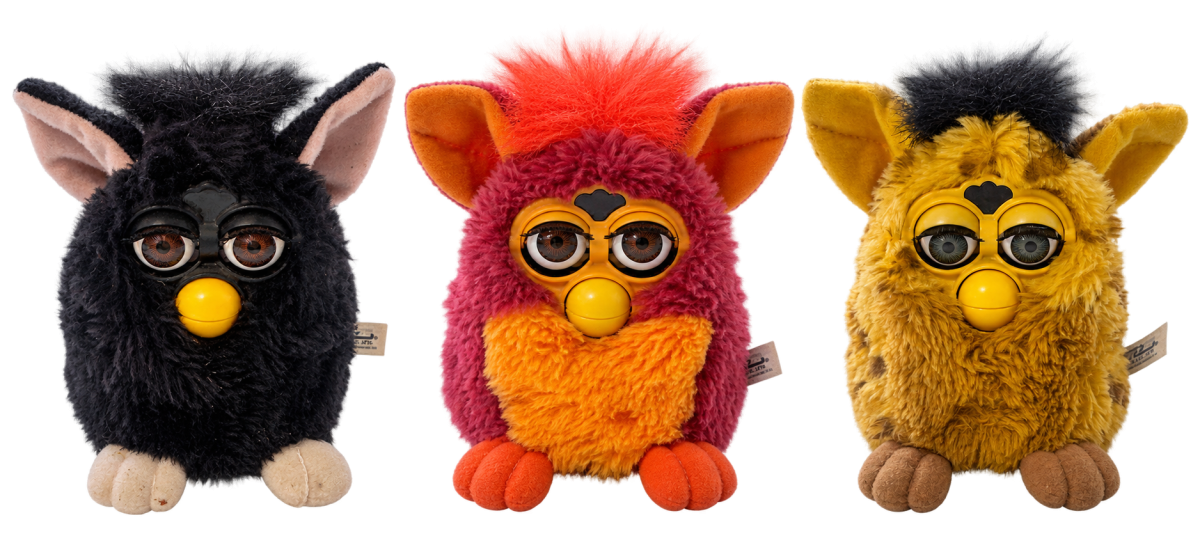
Furby was one of the biggest toys of the decade, and even though it wasn’t the kind of thing you could take to school, it belongs on this list all the same. I can’t picture anyone actually bringing one in, but the hype around it was a constant topic of schoolyard conversation and everyone’s Christmas list. Tiger Electronics released it in October 1998 and sold 14 million in 1999 alone. It even got banned from US National Security Agency facilities over fears it could record classified information, which it couldn’t. Hasbro has relaunched it several times since, most recently in 2023. My sister had a white one, seen above being held hostage by me for a photo. Years later, I started picking up random ones from op shops for a few dollars each, including the three below, as part of a big display of cool retro toys I had going at my office. When I changed jobs, the display got disbanded, and since Furbys are properly collectable again now, I sold them on eBay instead of just chucking them out.
Furby also kicked off a wave of hyped-up robot pets that dominated Christmas lists for years afterwards. Sega’s Poo-Chi robot dog followed in 2000, and RoboSapien from WowWee showed up in 2004, both riding the same wave of “my robot toy can think for itself” excitement that Furby started.
Pokémon Cards
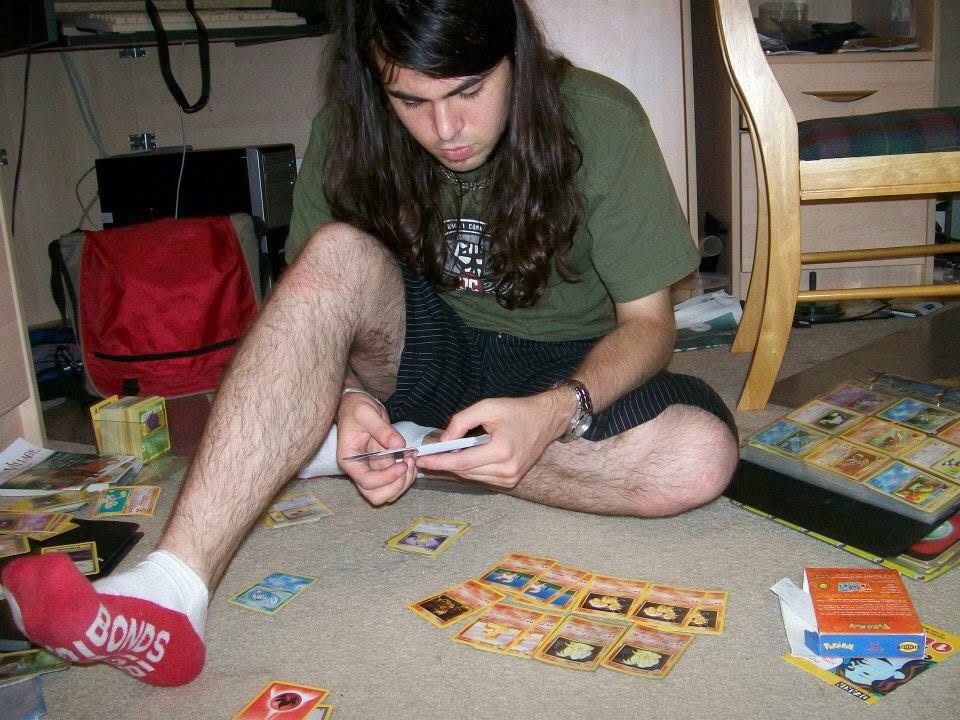
Me in 2009, building a vintage deck to play my friend Brian in the US over webcam.
This was the big one. The trading card game came out in Australia in mid-1999 and Australians spent $11 million on cards in the first two months. It also caused a proper moral panic, with a Channel Seven story featuring a Sunshine Coast pastor who warned the cards were turning kids towards witchcraft and violence, as a Guardian piece on Pokémon’s 30th anniversary recalls.
Funnily enough, I wasn’t interested in Pokémon at first. I never liked anime as a kid because everything looked the same to me. Then someone gave me my first card, which I think was a Nidorino, and one morning before school I caught an episode on Cheez TV. It was the one where Ash rides a Ponyta in a race and it evolves into Rapidash right before the finish line. That was it. I was instantly hooked on the monster designs.
Australia was quite a bit behind on the English sets. Jungle, the second set, came out in the US on 16 June 1999, while we were still getting started on the first one. I went to the USA in 1999 and came back with a single packet of Jungle cards, which immediately made me the most interesting kid in the schoolyard. That was confirmed my first ever packet, as Dad hadn’t wanted me buying them before that.
I remember trading one of the common cards from it for one of every energy card type, which was probably a terrible deal at the time, although still nowhere near as bad as my Mighty Max sale. If it included a Double Colorless Energy, though, it might have worked out in the long run. It was the only energy card in those early sets that gave you two energy at once, which made it one of the most useful cards you could have in a deck. It’s also the kind of card that gets reprinted every so often in the modern game, so an old vintage copy can still be perfectly playable whenever it’s legal in the current format.
Lunchtime trades going wrong got the cards banned at plenty of schools, and Bulbapedia notes some Australian schools saw them as a classroom distraction. At my school, it was down to bootlegs. Another family went to Bali or somewhere similar and came back with a stack of very dodgy looking fake Pokémon cards that were entirely holographic and turned out to actually be stickers. Cards ended up being somewhat banned after one of the girls’ parents complained she was getting ripped off in trades. The way I saw it, if she was swapping fake stickers for real cards, she was the one winning.
Pokémon wasn’t the only card game going around. A few kids had Dragon Ball Z cards, which Score Entertainment released in 2000, but they were never massive like Pokémon, where almost every kid had at least a few. Yu-Gi-Oh! followed, with the card game launching in North America in 2002, but I was in high school by then and never even saw any.
For me, Pokémon wasn’t just a schoolyard thing. Around 1999 and 2000, my friend Anthony and I went to the Pokémon League at Toys “R” Us at Highpoint. I think that was where it went from trading cards at lunch to actually learning the rules.
It stuck with me well past school too. In 2009, that’s me above digging back through my collection to put together a proper vintage deck, so I could play my friend Brian in the US over webcam. There was no online version of the card game back then, so playing someone overseas meant both of you holding your cards up to the camera and trusting the other person wasn’t cheating.
It went even further than that for me. From around 2011 to 2018, roughly the Dark Explorers set through to the early Sun and Moon sets, I actually played competitively, and placed 10th out of about 400 players in my age group at the Australian National Championships. I’m honestly glad I got out when I did. Looking at how big the hobby got again during COVID, I think I would have found the whole thing unbearable if I’d still been in it.
Pokémon turned 30 this year, and the cards are still going strong.
Pokémon Game Boy Battles
The cards were one thing, but the real schoolyard battles happened on the Game Boy, with two kids hunched over a link cable at lunchtime.
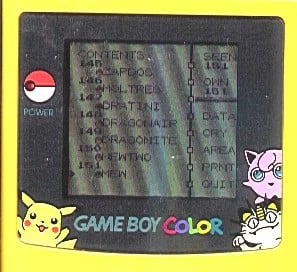
The holy grail was Mew. It was the 151st Pokémon, and you couldn’t catch it in the game normally. In Australia, the official way to get one was the PokéTour in 1999, which visited Victoria between September and October. You brought your Game Boy and cartridge, plugged it into a special unit and it downloaded Mew straight onto your game. You could also post your cartridge to Nintendo if you couldn’t make it. I didn’t do either.
This is where I have to admit I cheated a bit. I learnt the Pokémon duplication trick, which involved resetting your Game Boy at exactly the right moment while saving at the PC, so the Pokémon ended up in both your party and your storage box, as explained in this rundown of the Gen I cloning glitch. That meant I could clone a Mew that had come from the PokéTour without ever going, which made me feel like a genius.
I was so proud of my Mew that I scanned my Game Boy screen and put the photo up on a website Dad made me back in 2000, on a page proudly declaring me a “Pokémaniac.”
It didn’t stop there. I exploited every bug I could find to get Pokémon above level 100, which was possible in the original games if you knew how to break the level cap, and I maxed out their attack, defence, HP and PP. I had a Snorlax, a Muk and a Kangaskhan all sitting at level 255, thanks to the MissingNo glitch and rare candying them up well past where the game was ever meant to go. So even when someone brought a level 100 Pokémon to a battle, mine were always slightly stronger. I’m pretty sure that made me the best at my school, although whether it counts when you cheated is another question.
At the other end of the scale, Sydney hosted the first ever Pokémon World Championship in September 2000, right in the middle of the Sydney Olympics, played on Pokémon Red, Blue and Yellow, which I had no idea about at the time.
3D Action Cards
Once Tazos had proven kids would buy chips just for what was inside, the chip companies started putting in lenticular cards, the ones with a ridged plastic surface where the picture moved or changed when you tilted it.
[NOTE FOR KEITH: Photograph your own Goosebumps 3D action cards here]
The Goosebumps ones came first, with a set of 60 action cards in 1997, mostly animated versions of the book covers. There was a second set not long after, which I remember being scenes from the TV show instead. Then came the Pokémon Stadium Action 3D’s in 1999 and 2000, which turned up in Twisties, Lay’s, Burger Rings, Cheetos and Doritos. There were 50 in the set, plus a bonus Meowth that came with the collector album.
[NOTE FOR KEITH: Photograph your own Pokémon Stadium Action 3D’s here]
Digimon got their own version in 2000 with the Digi-FX cards, a set of 66 where tilting an Evolve-FX card showed a Digimon digivolving into its next form, per this Digi-FX checklist. Others were labelled Power-FX and Evil-FX.
[NOTE FOR KEITH: Photograph your own Digimon Digi-FX cards here]
Goosebumps & Animorphs
If you went to primary school in Australia in the 90s, you’ll remember the Scholastic book fair and those Book Club order forms, and you’ll remember that two series ruled them both. The first was Goosebumps. R.L. Stine’s first book, Welcome to Dead House, came out in 1992, and the series has since sold over 400 million copies, which is often described as second only to Harry Potter. At its peak in the mid 90s, it was selling around 4 million copies a month. Goosebumps was an anthology series, a bit like The Twilight Zone, mostly unrelated stories with the odd sequel thrown in, so you could generally read them in any order. That meant the cover art usually did the heavy lifting in deciding which one you picked up next. I think my first one was Piano Lessons Can Be Murder, the 13th book, which I picked because I was doing piano lessons at the time. The series has reprinted plenty of the books since and pumped out all kinds of modern spin-offs, but I only collect the vintage stuff. My original copies ended up with my dad’s friend’s son, who I doubt ever read one of them. Goosebumps also made its way into the classroom through an enormous amount of stationery. Folders, binders, pencil cases, erasers and pencils all got the Goosebumps treatment, so even kids who weren’t reading the books were probably carrying one around in their bag somewhere.
The other was Animorphs, which Scholastic published between 1996 and 2001 across 54 main books, or 64 once you count the Megamorphs, Chronicles and Alternamorphs spin-offs. The covers showed the narrator halfway through turning into an animal, and there was a flipbook animation in the corner of the pages, so you could watch the morph happen. I think half the fun was flicking through that before you’d even started reading. Unlike Goosebumps, Animorphs was meant to be read in a specific sequence, which got harder to keep track of once various side-story books started appearing between the numbered main series. Each book was still a self-contained adventure or battle in its own right though, usually with a fairly repetitive intro that brought you up to speed on the lore, which you really notice if you read or listen to a few of them back to back. I mostly borrowed these from the library rather than buying them, since I was already subscribed to Goosebumps through the Scholastic Book Club and there were simply too many Animorphs books to keep up with otherwise.
I’ve become properly invested in Animorphs as an adult. In my thirties I finally went back and started the series again from book one, and this time I actually finished it. Scholastic started releasing uncut Animorphs audiobooks on Audible in 2020, with a different narrator for each of the six main characters, and I’ve bought every single one. At around $14.95 each, that’s dumb money for books that only last three or four hours, even after chaining a few coupons to get some for free, but I’ve relistened to most of them three or four times since they started coming out.
Animorphs never really had the same merchandising push as Goosebumps, at least not that I remember here in Australia. About the only thing that stuck with me was the bookmarks that came free with some of the books, which were genuinely good. I’ve also picked up a lot of the really weird Animorphs toys as an adult. Hasbro released them in 1999 alongside Transformers, even though the two had nothing to do with each other, and the line flopped so badly that some of the moulds were reused for Transformers: Beast Wars. The first few books have also been turned into graphic novels since 2020, so it’s clearly not just me who never let go.
Harry Potter
I got into Harry Potter after the third book, Prisoner of Azkaban, had just come out in 1999, because my mum read about them in a women’s magazine. I remember tearing through each one in just a few days. Then the fourth book made them massive. Goblet of Fire came out on 8 July 2000 with a record first print run of over five million copies, and 3 million sold in the US in the opening weekend alone. It bugged me at the time that so many kids at school seemed to be starting the series from book four instead of reading it from the beginning.
Harry Potter is probably the only thing on this list that made reading itself cool. Suddenly kids were sitting around at lunchtime with their own copies, which wasn’t something I’d ever really seen before. I don’t think it took over the schoolyard the way some of the other crazes on this list did, but it was overwhelmingly popular and constantly talked about, just in a different way.
Harry Potter is also the reason I never finished Animorphs as a kid. Once I’d started, there was no going back, at least not until the audiobooks came along decades later.
No book had ever gotten me that hooked or reading that fast before, and nothing really has since. It’s a shame the author turned out to be such a trash bag, but that doesn’t change what the books meant to me at the time.
The thing is, I only ever read the first four books. The movies killed it for me. I couldn’t stand Rupert Grint at the time, and I didn’t think Emma Watson suited Hermione either. They were just so far removed from how I’d pictured the characters that I only made it through the first two or three films before I gave up on the whole franchise until I was in my thirties. I have no beef with either of them now. In my thirties I started the series again from book one, this time on Audible, and actually finished all seven along with the movies. They did a good job, just not the one I had in my head.
The Console Wars
The big one at my school was N64 versus PlayStation, and I was firmly on Team Nintendo. The PlayStation launched in Australia in November 1995, with the N64 following in March 1997, so plenty of kids already had a console and a side picked well before I got anywhere near one.
The consoles themselves never actually made it to school, unlike a Game Boy. As far as I knew, the Game Boy was the only decent handheld around at the time. I didn’t even know the Sega Game Gear existed as a kid, and I didn’t see an Atari Lynx until Stefan showed me his years later in high school. But even without the hardware in the room, arguments over which home console was actually the best were a constant fixture of the playground. I don’t remember anyone ever bragging about their Sega console, though. If Sega Genesis, Saturn or Dreamcast owners were out there, they were keeping it to themselves.
My dad was the editor of a PC magazine, so consoles weren’t exactly encouraged at home. I think his view was that you could just keep upgrading the same PC forever, and he wasn’t a fan of consoles because you couldn’t do much of that with them. For me it was never about the hardware anyway, it was the game franchises you simply couldn’t get anywhere else, things like Mario, GoldenEye and Pokémon. I didn’t get my first Game Boy until 1999, and only then because I needed something to play on the plane for a trip to the USA. An N64 followed in 2000, which meant I missed a good chunk of the actual console war being fought at school. That didn’t stop me from having an opinion. Whenever I was at a friend’s house, I still gravitated towards the Nintendo games over whatever their PlayStation had to offer.
Late in 2000, I went to orientation day at my new high school, where I didn’t know a single other kid from my primary school. I ended up talking to a kid called Stefan purely because we were both into the N64, and we’re still friends to this day.
Every console generation since seems to bring its own version of this same argument, whether that’s PlayStation versus Xbox, or Switch versus whatever else is around at the time. I’ve come around to thinking most major consoles have a great library of games and are genuinely all good. The competitiveness of arguing over which one is better feels a lot like backing a sports team, mixed with a bit of confirmation bias that you bought the right thing and a reluctance to admit any buyer’s remorse. These days, as an adult with adult money who can buy whatever I want, I’ve owned every major console from the 90s and 2000s through to today, and I enjoy a much wider range of them. Charlie and I mostly play the PS5 and Nintendo Switch together, and we rarely touch the Xbox consoles, but I still appreciate what they offer. My console wars are finally at peace.
Disney Adventures, K-Zone, MAD & Gaming Magazines
Before we could look everything up online, magazines were how you kept up with the latest games, shows and toys.
Disney Adventures started in 1990 and ran until 2007, and the Australian version was published locally by ACP for over a decade. It mixed Disney content with non-Disney articles on things like Harry Potter and anime, according to Wikipedia. I gave nearly all of mine to Stefan, the same friend I met over our shared N64 obsession, and only kept the ones covering Pokémon and Star Wars.
K-Zone was our own home-grown one, a monthly Australian magazine covering toys, gaming, anime, sport and entertainment, which is still going today. It even had its own freebies tied into other crazes on this list, with some bonus Yu-Gi-Oh! Tazos offered through the magazine, per the list of Australian Tazos. These days I snap up old issues of K-Zone and Disney Adventures whenever I come across them.
Then there was MAD Magazine, which had been around since 1952. Australia got its own edition in December 1980, and it was never just a straight copy of the American one. It always had US material in it, but it also had its own covers and some original Australian content, according to this Australian MAD history.
In the 90s it was still pretty good, with new pop culture parodies every issue, but in recent years it was mostly the same old material over and over. The American side had been struggling for a while. MAD had over 2 million subscribers in the early 70s, but readership dwindled dramatically after that, and in 2019 DC announced it would stop making new content, pull the magazine from newsstands and fill future issues with reprinted classics wrapped in new covers, blaming low sales. The Australian edition was only printing around 5,000 copies at that point, per Mediaweek, but it kept going until 2022, so ours outlasted the American newsstand version by a few years. Once I knew it was dying off, I bought it every time I saw it at my local newsagent, and I’m still amazed it lasted as long as it did.
I’ve still got a scar on my knee from MAD. I was carrying a whole box of them to school once, tripped on my comically long shoelaces and went down hard.
Video game magazines were just as important. They were where you found hints, cheats, walkthroughs and news on upcoming games, and a good cheat code could make you a legend at lunch for a day. Hyper, which launched in Australia in 1993, was a good one for covering every console, but I was ride or die Nintendo only during my school years. My favourites were N64 Gamer and Nintendo Gamer, which were actually the same Australian magazine. It started in 1998 as N64 Gamer and was renamed Nintendo Gamer as the Nintendo 64 wound down.
Gel Pens
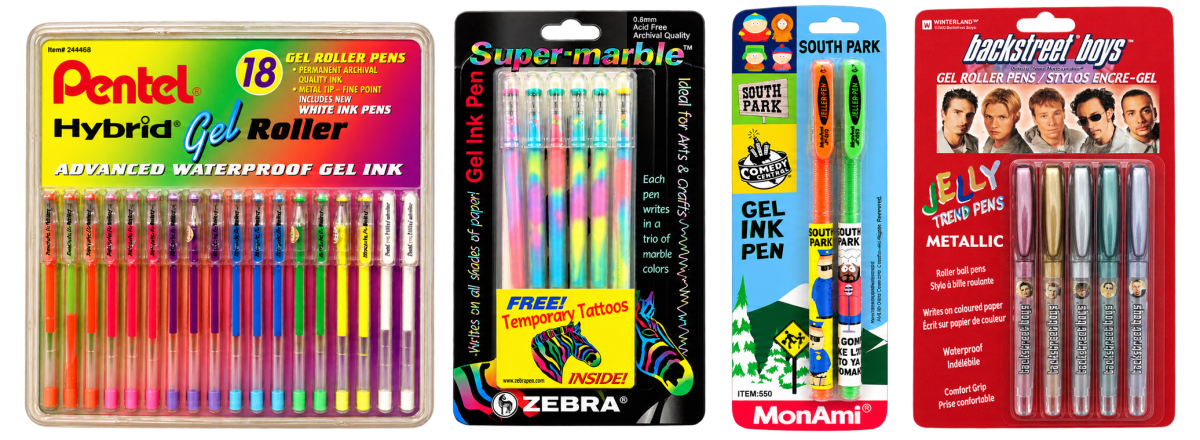
Gel pens weren’t technically a toy, but they worked like one. Sakura invented gel ink in Japan and launched its first gel pen in 1984, but the ones we all wanted came later. According to Gelly Roll’s history, the metallic range arrived in late 1997 and the glittery Stardust pens followed in January 2000, right around when every pencil case in the class suddenly had 30 of them.
The whole point was the colours. Black and blue were boring, and gold and silver seemed super fancy. I used to do my homework and school presentations in as many colours as I possibly could. I remember going through a lot of Pentel ones, and I definitely had a set of MonAmi gel pens with cartoon characters printed on the barrels, like the South Park ones pictured above.
Naturally, some schools banned them too. Around 2001, teachers in the US were complaining that the ink stained desks and carpets, the writing was often hard to read, and kids were collecting them in distracting quantities, as this rundown of items banned from schools explains. I can only imagine how many kids were doing their homework in light blue, hot pink or some other equally silly colour that made it borderline impossible to read.
Scented Stationery
Pens weren’t the only thing in your pencil case that had to smell like something. Mr Sketch scented markers had been around since 1965, with the eight original scents including cherry, blueberry, grape and a genuinely unpleasant black liquorice, and they were still doing the rounds in classrooms decades later. Teachers loved handing out scratch and sniff stickers as rewards too. The technology was invented by accident at 3M in the 1960s while someone was actually trying to improve carbonless copy paper, and it works by trapping tiny capsules of scent that burst open when you rub them. Scratch and sniff strips also turned up in magazines every now and then, usually as an ad, which felt like a novelty every single time.
Looking back, getting a whole generation of kids used to sniffing their pens and markers probably wasn’t the smartest idea. It’s not exactly a stretch from there to chroming, something I wasn’t even aware of as a problem until a family holiday to New Zealand, where I saw a fair few people huffing paint on trains and park benches.
[NOTE FOR KEITH: Any personal memories of scented markers, scratch and sniff stickers, or other smelly stationery you had as a kid? Happy to add a photo here too if you’ve got one.]
Faber-Castell Connector Pens
Every Australian pencil case had a set of these at some point, and they were always properly good quality texters, not just a novelty. Connector Pens are fibre-tip markers with a special clip on the cap that lets you snap them together end to end, so you could build your own long, colourful chain out of your whole set. There were also Super Connectors, which could hold two pens at once, and I feel like there was a bit of a push in the 90s to bring out angled connector pieces too, so kids could use their pens almost like a construction toy, seen below.
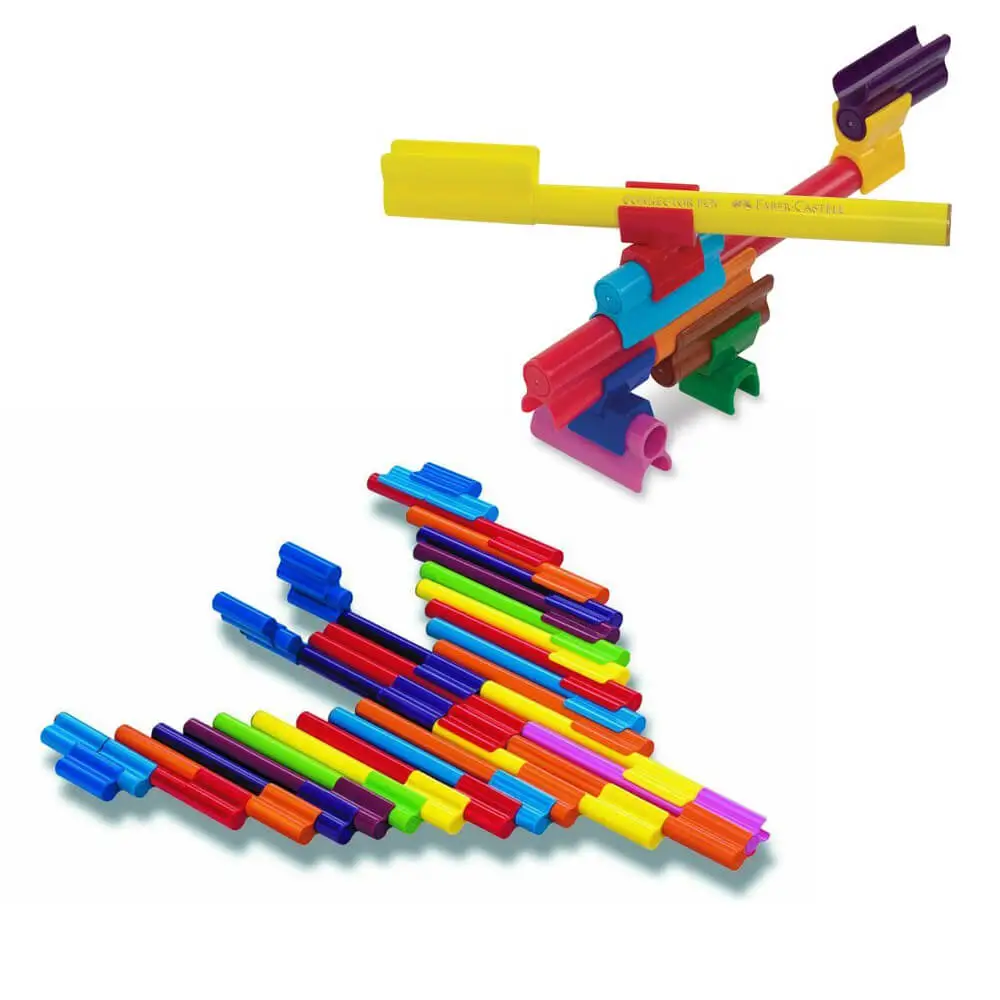
The rotatable clip design meant you could also use them to draw parallel lines or make up your own little games with them.
Paper Fortune Tellers & Yes/No Erasers
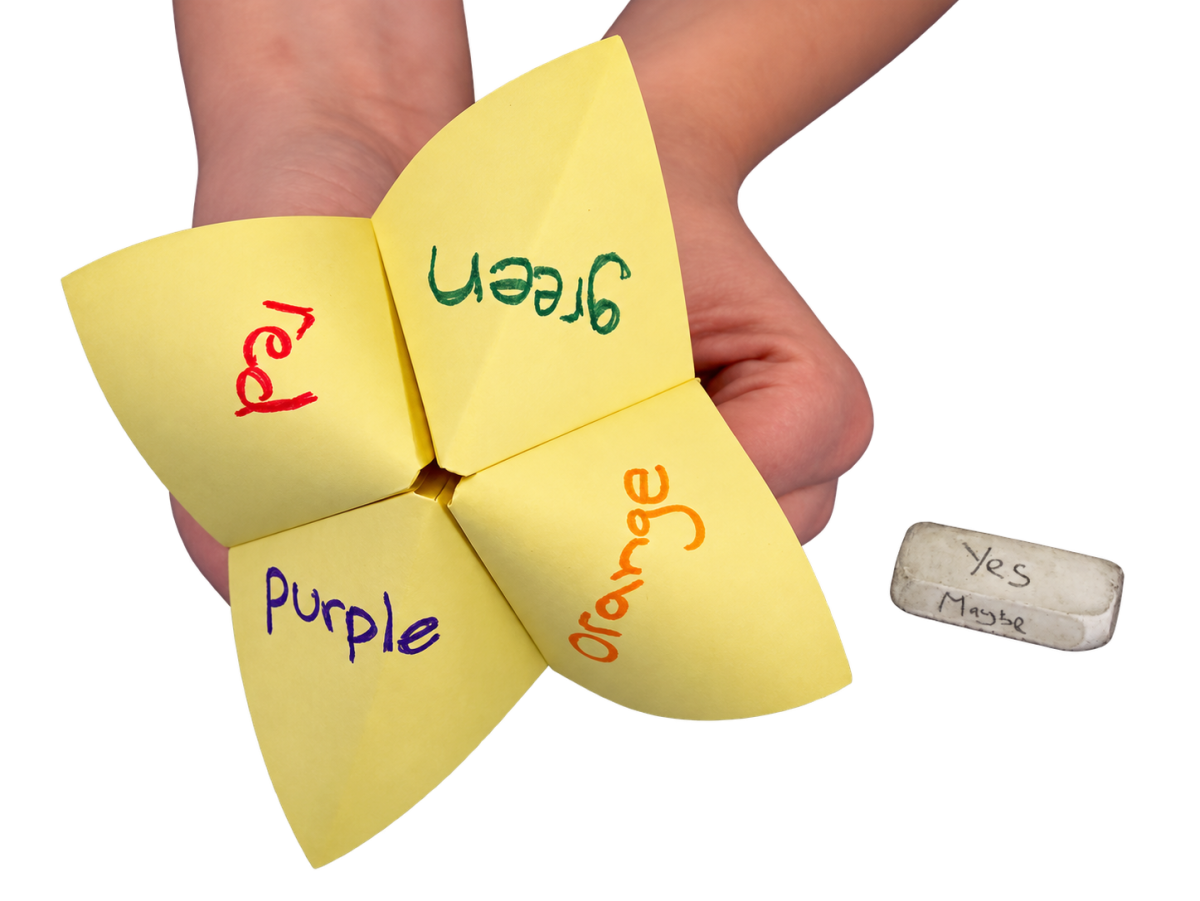
When you had a big question that needed answering in class, you made your own fortune teller. The fancier option was the paper fortune teller. You’d fold a square of paper into that little four-pointed origami shape, write colours and numbers on the outside and fortunes under the flaps, then open and close it with your fingers while someone picked their way to an answer. They go by a lot of names, including cootie catcher and chatterbox, and they’re much older than I would have guessed, with the first clear picture of one turning up in a German children’s book in 1876, according to Wikipedia.
The lazier option was your eraser. It didn’t cost anything, which is probably why everyone did it. You’d write “yes” on one side, “no” on another and maybe “maybe” or “ask again” on the rest, then roll it on your desk like a dice. It was a homemade version of the Magic 8 Ball, just a lot less optimistic, since half of the real one’s 20 answers are positive.
The Cool S
Every kid, in every country, in pretty much every decade, seemed to know how to draw the Cool S, that pointy, zigzagging S shape that ended up doodled in the corner of practically every workbook. There are very specific steps to drawing it, so someone definitely showed me how at some point, even if I can’t remember who. It’s not really a doodle you could just stumble onto.
I think part of why it caught on so hard is that it looks properly geometric and rigid, almost like a real font or logo rather than your average border doodle, which made it feel like something worth learning properly. It also lent itself perfectly to showing off. You’d watch someone draw it and go “that’s easy, you just do three lines like this, then this, then this,” and suddenly you could draw it too and had someone else to show.
Nobody can actually pin down where it came from, despite plenty of people trying over the years. It’s definitely not connected to the Superman logo, the Stüssy clothing brand or any gang, whatever you might have heard growing up. What I can’t work out is how something that presumably started somewhere in the US made its way all the way to Werribee Primary School in suburban Victoria, with seemingly no adult ever having taught it to anyone along the way.
Tech Decks
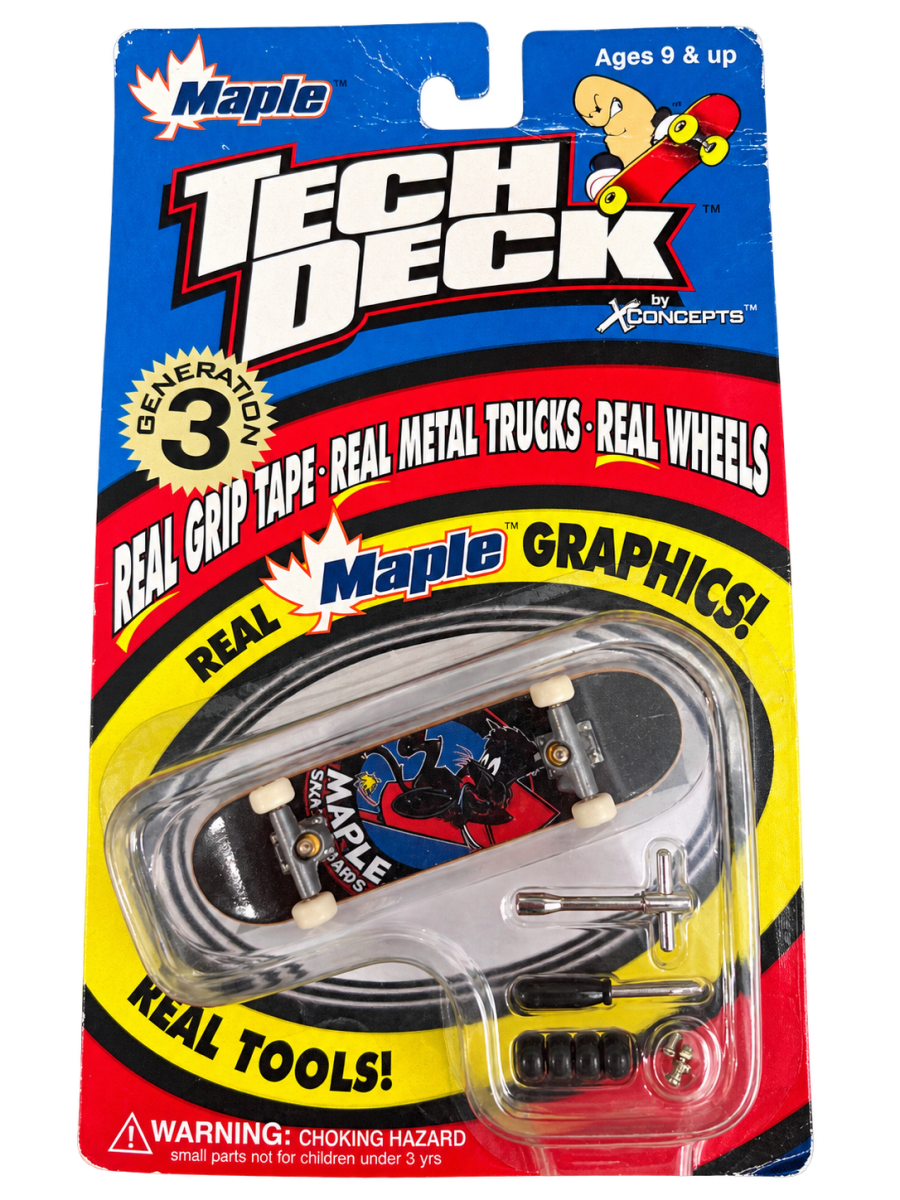
Tech Decks were tiny fingerboards, basically a skateboard for your fingers, and they dominated pencil cases and desk lids in the late 90s and early 2000s. They were made by X-Concepts and, the part that made them cool, they carried real skate brand graphics like Birdhouse, Blind and World Industries, according to this Tech Deck brand history. The Generation 3 one above is from around 1998, so they were already on their third version before most of us had even heard of them. Spin Master bought the company in the mid 2000s and still makes them today.
You’d use two fingers as legs and try to ollie over a pencil, grind along the edge of your desk or build ramps out of books. I think a lot of their popularity came from the Tony Hawk video games. Tony Hawk’s Pro Skater came out on PlayStation in September 1999 and is credited with bringing skateboarding to a mainstream audience, so suddenly every kid knew what a kickflip was without ever having stood on a board.
I didn’t own one as a kid. I got my first Tech Deck in my 30s, when a guy at work bought some for everyone. I’ve since bought a few for my kids, who have never really played with them, but I’ve found they’re the perfect scale for action figures, so they haven’t gone to waste.
Marbles
Marbles had their moment too, although I don’t remember any particular brand or marketing push behind them. They feel like one of those games that will always be around in a schoolyard, whether or not anyone is selling them as the next big thing.
I always liked the ones with interesting colour effects and patterns, not the boring generic cat’s eyes that everyone seemed to have a bag of. There’s a reason there were so many of those. Cat’s eye marbles were invented in Japan around 1945, and they were so cheap to make that they pushed most American marble makers out of business in the 1950s, according to this brief history of marbles.
My favourites were the transparent blue ones, mostly because they doubled as energy balls for my Star Wars figures. I did end up with some Pokémon-branded marbles too, though that was well after my original interest in marbles had faded.
Downball & Bat Tennis
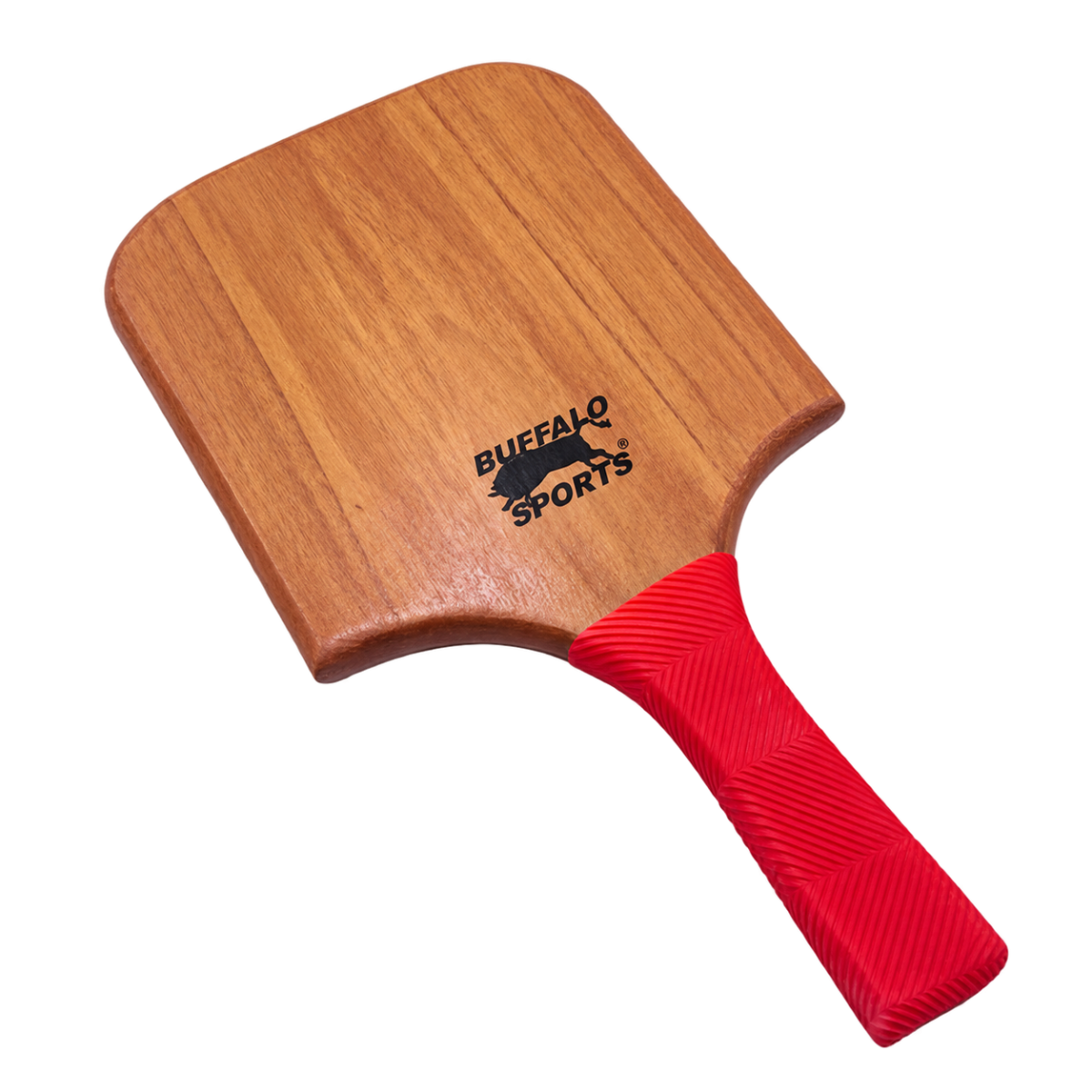
Not every craze came from a shop. The two games that took over our playground were downball and bat tennis.
Downball goes by a lot of names around Australia, including handball and four square, but the idea is the same. You’ve got a court split into four squares, ranked from king down to dunce, and you bounce the ball into each other’s squares until someone stuffs up and has to move down. It’s apparently still going strong, with a Melbourne teenager starting Australia’s first downball league a few years ago.
Bat tennis was a smaller version of tennis played with wooden bats instead of racquets. It even shows up in a University of Melbourne record of Australian playground games, although the kids there were using plastic bats. At my school, both games were played on the same courts, and bat tennis had its own very low wooden “net” built into the ground rather than anything you’d actually recognise as a tennis net. One of our primary school teachers used to make wooden bats for the kids, and I remember spending more time sanding mine down and getting the grip just right than I ever did playing with it.
Bike Pegs
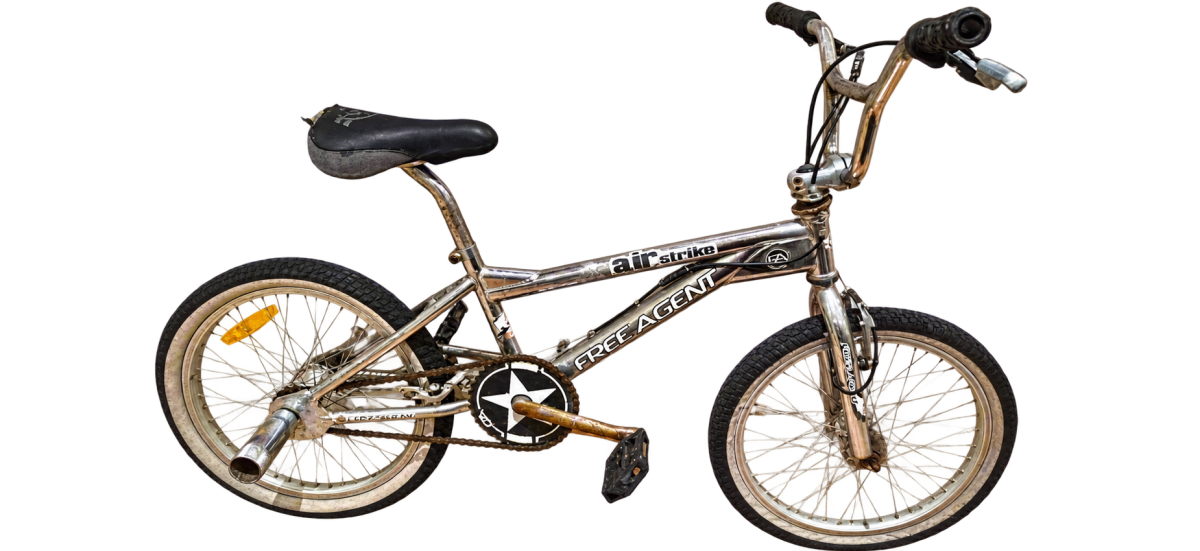
Bikes weren’t something you played with in the schoolyard, but plenty of kids rode to school, and we even had bike education classes in primary school. At some point it felt like every kid with a BMX decided they needed pegs, the metal tubes that bolt onto your wheel axles and stick out either side. I never put pegs on my own bike, but lots of other kids did.
In theory they were for grinding along kerbs and rails like the pros. In reality, they were mostly for doubling a friend home, with them standing on the back pegs and holding onto your shoulders while you wobbled down the street. That’s exactly the kind of thing I’ll be telling Charlie and Alex not to do.
My own biggest bike moment had nothing to do with pegs. Those same comically long shoelaces that tripped me up carrying my MAD magazines got caught in my chain during one of our bike ed sessions and sent me crashing to the ground.
Razor Scooters
If you didn’t ride a bike to school, there’s a good chance you rode a scooter. The Razor scooter was first released in June 2000, and it wasn’t long before foldable aluminium scooters were everywhere. They didn’t actually end up lined up outside the classroom the way bikes did, though. More often than not a parent would just take it home again after drop-off, and if you’d ridden to school without a parent, the scooter folded up small enough to shove in your school bag for the day.
My sister and I eventually got generic foldable ones rather than proper Razors. Hers was super heavy, and you did not want to get hit in the ankles with the deck, the flat bit you stand on. I later got a much lighter one, which was better, right up until something in the front wheel came loose. After that, the slightest bump would turn the wheel sideways while the handlebars stayed facing forward, which sent me flying more than once.
Butterfly Clips
If you were a girl in the 90s, butterfly clips were pretty much essential. They were tiny plastic clips with a little butterfly on top, and the more you had in your hair at once, the better. Some did a proper job of keeping your hair out of your face, but most were just there to look good, as this look back at 90s hair accessories points out. My sister had plenty of them. They’ve been making a comeback in recent years too, so they’re easy to find online if you want to relive it. I recently bought a pack for my niece on Amazon, and couldn’t resist seeing how they’d look on me too.
Lip Smackers & Mood Rings
Two more things that seemed to be in every girl’s pencil case or on every girl’s finger. Lip Smackers, the flavoured lip balm from Bonne Bell, actually goes all the way back to 1973, with Strawberry, Green Apple and Lemon as the original three flavours. The real coup came in 1975, when Bonne Bell struck a deal with Dr Pepper, and the soft drink flavour went on to become one of the brand’s best sellers for decades. By the 90s there were dozens of flavours doing the rounds, swapped and collected as much as they were actually used.
Mood rings had an even longer history before they hit our schoolyard. Josh Reynolds and Maris Ambats introduced them to American stores in 1975, using thermotropic liquid crystals that shift colour based on skin temperature. They were never actually reading your mood, just how warm your finger was, but that didn’t stop anyone from taking the colour chart seriously. The original fad faded within a couple of years, but nostalgia brought them back for another run in the 90s.
At my school, mood rings were the girls’ equivalent of laser pointers. Every excursion to the Queen Victoria Market, while the boys were coming back with cheap laser pointers, the girls were coming back with mood rings.
[NOTE FOR KEITH: Any other personal memories here, like your sister’s collection or swapping Lip Smackers at school? Happy to add a photo too if you’ve got one.]
Spiked Hair & Blonde Tips
For the boys, it was all about the hair gel. Every second boy had spiked hair, and if you really wanted to stand out, you bleached the tips blonde. Frosted tips, as they were also called, were made famous by boy bands like NSYNC, with Justin Timberlake having never quite lived down his late 90s version. They’ve even tried to make a comeback, according to Maxim, although I haven’t noticed it catching on.
I used hair gel to spike my hair in primary school, but I never went as far as the tips. I’ve never dyed or bleached my hair at all, and I think that’s because Dad tried dyeing his hair in the 90s and had an allergic reaction. Seeing that was enough to put me off trying anything for life.
Laser Pointers
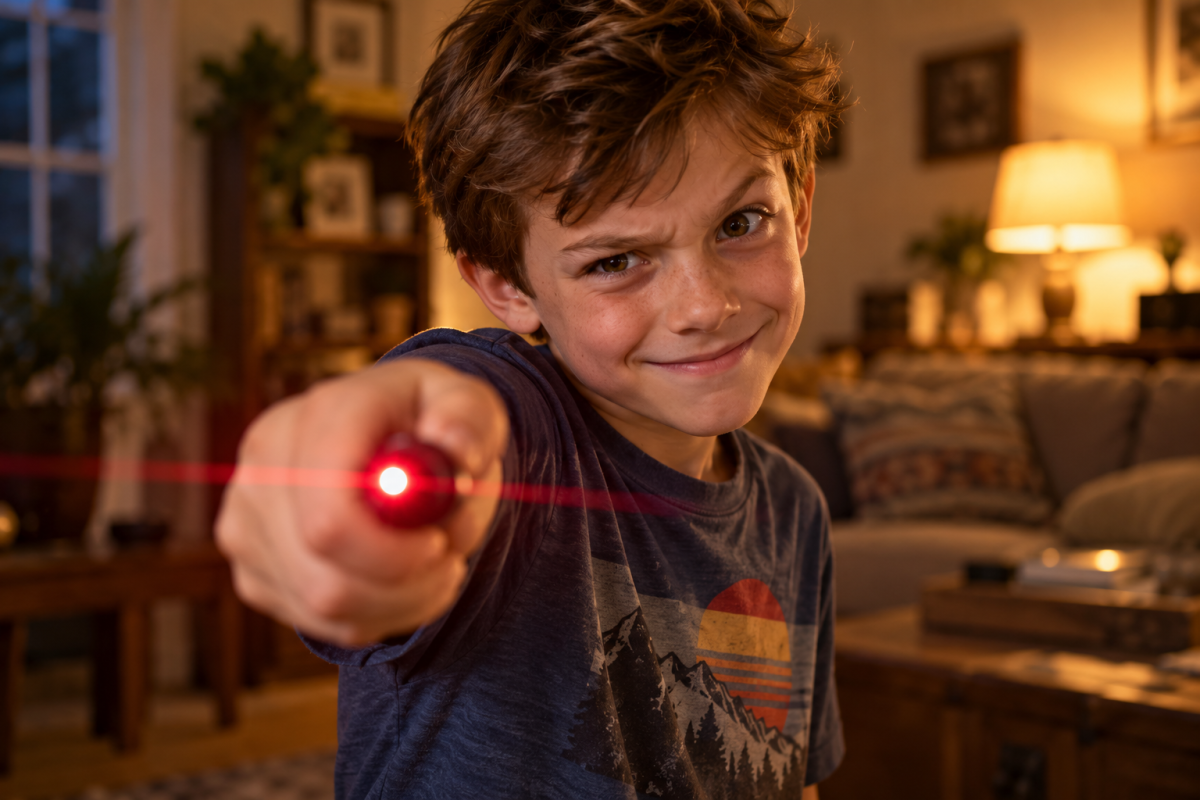
I can’t remember laser pointers being a thing in primary school, but they definitely were in high school. Every time we went on an excursion to the Queen Victoria Market, you could guarantee that about a dozen kids would come back with a cheap laser pointer, while the mood rings I mentioned earlier were more the girls’ pick from the same stalls. They weren’t bought for presentations. They were bought to cause trouble. I didn’t buy one, although I ended up with a few later on, which I think were conference freebies from Dad’s work trips.
Looking back, it’s a bit surprising how easy they were to get. That changed in 2008, when Australia banned the import and possession of laser pointers over 1 milliwatt after a series of attacks on aircraft over Sydney, giving us what MIT Technology Review called the most restrictive laser pointer laws in the world. I can’t imagine my boys coming home from an excursion with one now.
Yak Bak
Yak Bak was released in December 1994 by Yes! Entertainment, pitched as a cheaper alternative to Tiger Electronics’ Talkboy, the recorder made famous by Home Alone 2, according to Wikipedia. The original just recorded six seconds of your voice and played it straight back, but later versions added their own twist, like the Yak Bak WarpR, which let you pitch your voice up or down, and Yak Bakwards, which had a button that played everything backwards.
I never actually had a real Yak Bak. What I had was something very similar, a free promotional voice recorder Dad picked up at a conference in the US. It worked the same way, and I brought it to high school around 2001, which turned out to be a mistake. There was an older kid at my school called Eddie who’d somehow talked our vice principal into lending him the master key, and he was using it to go through lockers and steal phones for some older guy who was reselling them. My recorder went the same way. Eddie got expelled for it not long after.
Beyblades
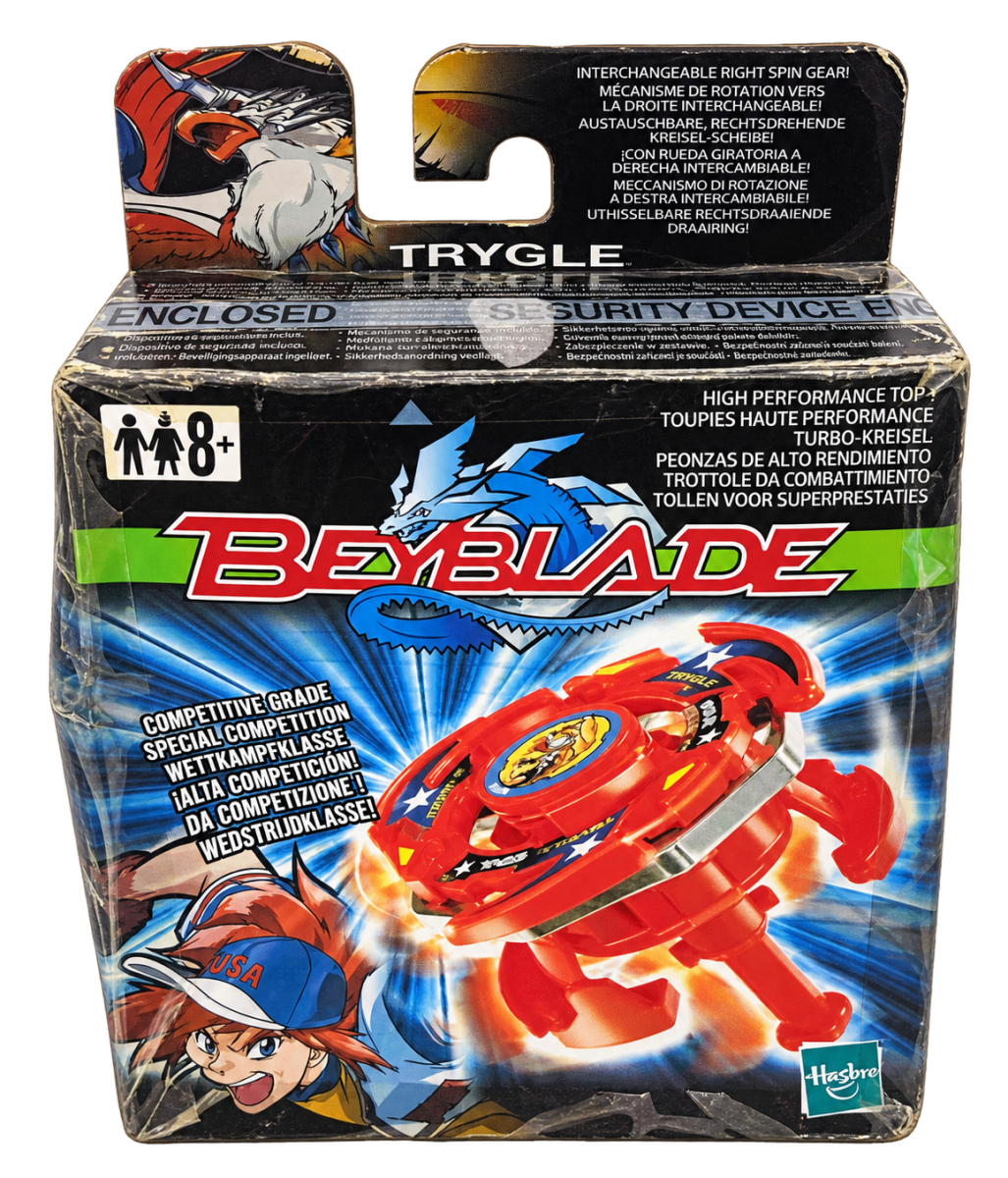
By the time Beyblades came along, I was already in high school, so I never really got into them. Hasbro started selling them internationally in 2002, and suddenly every primary school kid was yelling “Let it rip!” Beyblade’s history shows it’s been rebooted several times since.
What I do remember is that they got their own Tazo-style giveaway in chip packets. In mid-2003, Smith’s, Doritos, Cheetos and Twisties packets came with little Beyblade Tazo Topz, each with a character from the first season and a star rating on the back.
Like so much else on this list, the real ones got banned. It was usually because of fights, stolen Beyblades or kids getting hurt, and one English school banned them in 2003. I’m fairly sure it’s only a matter of time before I have to buy one for Charlie.
Camera Phones & Polyphonic Ringtones
I got my first mobile phone in 2001, which turned out to be the start of a device that completely rewired how we interacted at school. Nokia was king back then, and I don’t think there was a single kid who didn’t spend half their classes secretly playing Snake under the desk, the game that had been built into Nokia phones since the 6110 in 1997.
For the first couple of years it was all black and white screens and basic monophonic beeps, but that changed fast. Somewhere around 2003 and 2004, phones went from monochrome displays to colour almost overnight, and not long after that, a low resolution camera got bolted on too. Having a “camera phone” instantly became the new must-have, even if the photos it took were barely better than a potato. Actually getting those photos off the phone and onto a computer was its own ordeal too. I can’t even remember exactly how it worked, whether you plugged the phone in directly or had to go through your carrier’s website, but if you actually went to the trouble, you’d find the photo was about the exact size of the phone’s screen, which back then was roughly the size of your thumb.
Ringtones went through their own arms race at the same time. Monophonic beeps gave way to polyphonic ones that could play multiple notes at once and actually sound something like real music, built on the same kind of MIDI data musicians had been using for years. I couldn’t afford an actual polyphonic ringtone myself, so instead I’d track down or put together real MIDI versions of songs and set those as my ringtone, which got close enough to pass.
Jamster, or Jamba as it was known in some countries, cashed in hard on all of this. Their ads were everywhere, usually fronted by some branded character like Crazy Frog, and they pushed what looked like a one-off ringtone purchase but was actually an ongoing subscription that was a proper pain to cancel. It got bad enough that a petition in Germany against their advertising picked up around 200,000 signatures.
Then there was the social side of it all. Everyone wanted to show off their new ringtone, so you’d get people playing them out loud, over and over, completely unprompted, all day long. It was fucking annoying.
Jelly Bracelets
Jelly bracelets were thin, cheap, colourful rubber bangles that you’d wear stacked halfway up your arm. They first became popular in the 80s when Madonna wore them, then came back in the late 90s and early 2000s as 80s fashion came back around.
I didn’t wear them, but they’re probably best remembered now for the rumour that came with them. Around 2003, the story hit the news that each colour was a secret code for something sexual, and that if someone snapped your bracelet, you owed them whatever that colour stood for. Parents panicked and some schools banned them. What’s wild is that we already knew all the lore about the different colours back in primary school. The whole thing was almost certainly a playground myth, though, and Snopes found no evidence that kids were actually playing the game. The same kind of rumour had done the rounds decades earlier with soft drink can pull tabs.
The wristband craze has a habit of resurfacing. Around 2013, loom bands took over, with kids weaving tiny rubber bands into bracelets using a Rainbow Loom. It became one of the most popular toys in the world and, true to form, got banned from some schools for causing arguments. I suspect Charlie and Alex will have their own version before long.
Did I Miss Any?
How many of these did you have, and did your school ban any of them? I’ve almost certainly missed a few, so let me know on Facebook and I’ll add them. And if you’ve got kids at school now, I’d love to know what’s doing the rounds in their schoolyard, because I’ve got a feeling I’ll need to be ready.